Live Out of Love

At the start of every school year, Manna Christian Fellowship at Princeton University does a special Old Timers Large Group for sophomores, juniors, and seniors. What follows is the message I shared at this year’s Old Timers on September 3, 2025.
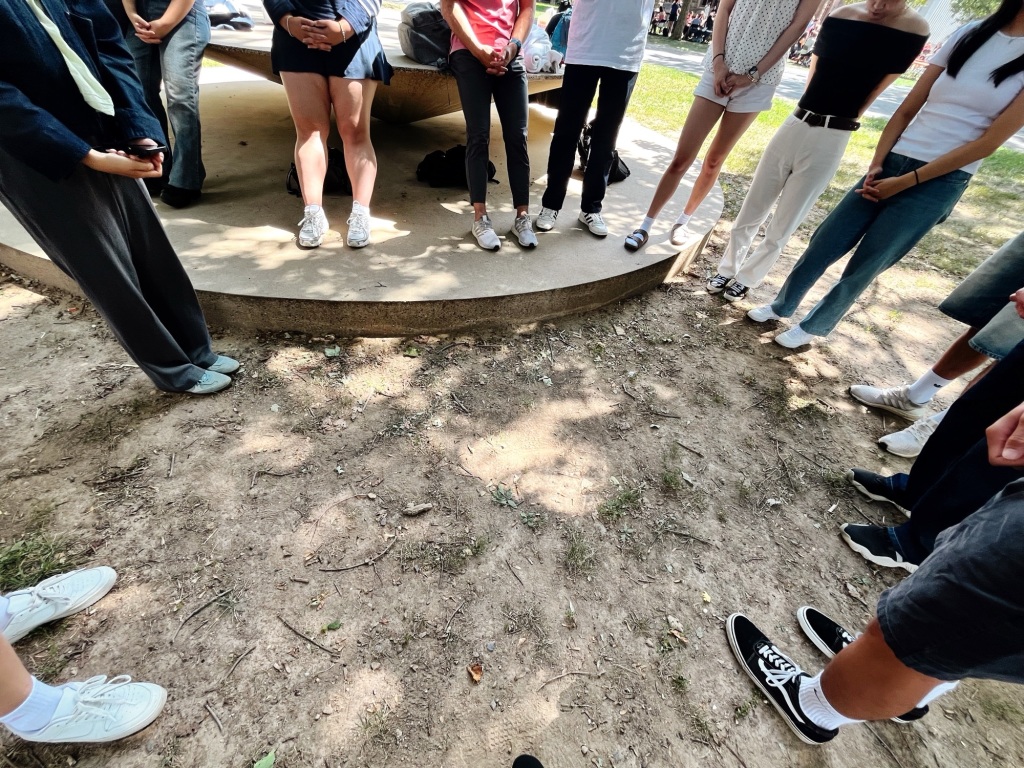
Prayer at “The Cone” sculpture before Manna’s first event of the school year, an ice cream social to welcome freshmen.

As we begin a new school year, here’s what I want you to get:

You are deeply loved by God.

And because you are deeply loved by God, 

love God with your whole being, and love people without exception.

There’s a term in theology and Biblical studies: “synoptic Gospels.” In Manna, we talk a lot about the Gospel, the good news of the Kingdom of God. That word, gospel, also refers to the first four books in the New Testament: Matthew, Mark, Luke, and John. All four of them give an account of the life and teachings of Jesus. And the Synoptic Gospels refers to three of those books: Matthew, Mark, and Luke. The reason they’re called the synoptic Gospels is because they’re quite similar and have a lot of overlap. And John, though he talks about the same Jesus and there’s some overlap as well, his book is very different from the other three. Why are there differences in the accounts of the life of Jesus? If you had four different people telling you about the life of [pick random student], you’d hear four different accounts, different details and emphases, different ways of describing the same person. All true, but just from different perspectives. For example, Daniel and I get asked so many times how he proposed. I tell that story very differently from the way Daniel tells it. Which telling is right or more true? They’re both right, and they’re both true. And hearing it from both our perspectives gives you a fuller picture.

So here’s what we’re going to do. We’re going to explore a story that’s found in all three of the Synoptic Gospels. And then, we’ll see what John, the author of the last Gospel, has to say about the matter. And as we explore, I want you to consider two questions:

  1. Do I live like love is as important as Jesus said it was? 
  2. What gets in my way of loving God and loving people?

The Perspective of Matthew

If you have your Bible, open up to Matthew 22. While you do that, let me give you some context. In the preceding chapter, chapter 21, Jesus rode into Jerusalem on a donkey, and there were palm branches, and people were shouting, “Hosanna to the Son of David!” It was basically a royal procession. And after that, Jesus went into the temple, and He started flipping over the tables of the money changers and those selling doves. This was happening in the Court of the Gentiles, the place that was supposed to be where those from every nation could come and worship God, but that place was being overrun by people who were distorting sacrifice and worship into a commercial endeavor, thereby excluding the nations to whom God had called His people to be a blessing. Jesus flipped the tables of injustice, and the religious leaders got mad and began to search for a way to do away with Him. So in chapter 22, we see various groups approaching Jesus, trying to trap Him with different theological tests/questions. In Matthew 22:34, we come to their last test to Jesus.

Matthew 22:34-40 (CSB)

When the Pharisees heard that he had silenced the Sadducees, they came together.  And one of them, an expert in the law, asked a question to test him: “Teacher, which command in the law is the greatest?”

He said to him, “Love the Lord your God with all your heart, with all your soul, and with all your mind. This is the greatest and most important command. The second is like it: Love your neighbor as yourself.  40 All the Law and the Prophets depend on these two commands.”

After this, Jesus turned around and presented them with a question and they weren’t able to answer Him. Then in Matthew 23:1-4, the story continues. 

Matthew 23:1-4 (CSB)

Then Jesus spoke to the crowds and to his disciples: “The scribes and the Pharisees are seated in the chair of Moses. Therefore do whatever they tell you, and observe it. But don’t do what they do, because they don’t practice what they teach. They tie up heavy loads that are hard to carry and put them on people’s shoulders, but they themselves aren’t willing to lift a finger to move them.

Jesus calls us to a love that is embodied and seen through action rather than being enslaved to legalism, perfectionism, purity tests, and the appearance of piety. 

The Perspective of Mark

Let’s look at Mark 12. The context here is the same as the book of Matthew: Jesus flipping over tables of injustice, the religious leaders trying to trap Him. But when we get to Mark 12:28, the tone shifts. 

Mark 12:28-34 (CSB)

One of the scribes approached. When he heard them debating and saw that Jesus answered them well, he asked him, “Which command is the most important of all?”

Jesus answered, “The most important is Listen, Israel! The Lord our God, the Lord is one. Love the Lord your God with all your heart, with all your soul, with all your mind, and with all your strength. The second is, Love your neighbor as yourself. There is no other command greater than these.”

Then the scribe said to him, “You are right, teacher. You have correctly said that he is one, and there is no one else except him. And to love him with all your heart, with all your understanding, and with all your strength, and to love your neighbor as yourself, is far more important than all the burnt offerings and sacrifices.”

When Jesus saw that he answered wisely, he said to him, “You are not far from the kingdom of God.” And no one dared to question him any longer.

What strikes me about Mark’s telling is that the scribe seemed genuinely interested. And Jesus’ positive response to him makes me wonder what happened to this scribe. Did he ever become a follower of Jesus? We don’t know. All we know is that in this moment, as he demonstrated an understanding of the supremacy of love, Jesus said he was “not far from the kingdom of God.” 

As we keep reading a few verses later, starting in verse 38,

Mark 12:38-44 (CSB)

He also said in his teaching, “Beware of the scribes, who want to go around in long robes and who want greetings in the marketplaces, the best seats in the synagogues, and the places of honor at banquets. They devour widows’ houses and say long prayers just for show. These will receive harsher judgment.”

Sitting across from the temple treasury, he watched how the crowd dropped money into the treasury. Many rich people were putting in large sums. Then a poor widow [Remember that Jesus just talked about scribes devouring widows’ houses.] came and dropped in two tiny coins worth very little. Summoning his disciples, he said to them, “Truly I tell you, this poor widow has put more into the treasury than all the others. For they all gave out of their surplus, but she out of her poverty has put in everything she had — all she had to live on.”

So many people preach this passage to say, you need to be like the poor widow and sacrifice everything you have for God. But read in context, this is not that. Nowhere does Jesus say that what this widow was doing was a good thing. He wasn’t criticizing her, but His words weren’t exactly praise either. It was more like lament. He was saying, “Here is a living example of the way scribes and religious leaders are devouring widow’s houses and causing them to be destitute. Look at the inequity of someone who has very little giving everything, while people who have everything give comparatively very little.” This year, our theme in large group is going to be “Jubilee.” You can read about the idea of Jubilee in Leviticus 25 and Luke 4:16-21. But for now what I want you to know is what was happening in this passage, what the religious leaders and rich people were doing and allowing to happen to widows was not jubilee and was antithetical to the Gospel. 

The scribe understood and could wax eloquently about the command to love God and love people, but there was a disconnect between the knowledge the scribes had and how they lived their lives. The scribes were pious and they prayed long prayers, but they were also greedy and unjust. Love does not tolerate injustice. 

The Perspective of Luke

Luke puts this story earlier in the narrative and in Jesus’ ministry. Jesus wouldn’t flip the tables of injustice until chapter 19. If you glance at the subject titles leading up to this point, you’ll see things related to Jesus’ identity and His mission, as well as His invitation to His followers to be like Him and participate in that mission (“Peter’s Confession of the Messiah,” “His Death and Resurrection Predicted,” “Take Up Your Cross,” “The Power of Jesus over a Demon,” “Sending Out the Seventy-Two…”). With that setup in mind, let’s read Luke 10:25-37.

Luke 10:25-37 (CSB)

Then an expert in the law stood up to test him, saying, “Teacher, what must I do to inherit eternal life?” 

“What is written in the law?” he asked him. “How do you read it?”

He answered, “Love the Lord your God with all your heart, with all your soul, with all your strength, and with all your mind,” and “your neighbor as yourself.”

“You’ve answered correctly,” he told him. “Do this and you will live.”

But wanting to justify himself, he asked Jesus, “And who is my neighbor?” 

This expert in the law was basically asking Jesus, “Who do I have to include and who am I allowed to exclude?” And Jesus’ response was scandalous. “You think you’re an expert in the law? Let me tell you a parable about how the kind of people that you look down on understand the law better than you.”

Jesus took up the question and said, “A man was going down from Jerusalem to Jericho and fell into the hands of robbers. They stripped him, beat him up, and fled, leaving him half dead. A priest happened to be going down that road. When he saw him, he passed by on the other side. In the same way, a Levite [another religious leader], when he arrived at the place and saw him, passed by on the other side. But a Samaritan on his journey came up to him, and when he saw the man, he had compassion. He went over to him and bandaged his wounds, pouring on olive oil and wine. Then he put him on his own animal, brought him to an inn, and took care of him. The next day he took out two denarii, gave them to the innkeeper, and said, ‘Take care of him. When I come back I’ll reimburse you for whatever extra you spend.’

Through the story of the Good Samaritan, we see a love that’s not abstract, but concrete:

What does concrete love look like? Three phrases:

  1. I see you.
  2. I’m here for you.
  3. I’ve got your back. 
  • The Samaritan didn’t just see that the man was there. The religious leaders saw him, too. But they didn’t see him in his full humanity, as someone created in the image of God and loved by God, who was suffering and in need of care. But the Samaritan truly saw him and was compassionate enough to stop.
  • He bandaged his wounds (which means he was willing to look at some ugliness)
  • He gave his resources: oil, wine, money. And where did he get bandages? Did he rip up his own clothes or another one of his valuables to make bandages for this stranger?
  • He gave his time, not just in that moment, but in the days to come.
  • And the Samaritan made sure the man was safe and out of harm’s way.

“Which of these three do you think proved to be a neighbor to the man who fell into the hands of the robbers?”

“The one who showed mercy to him,” he said.

Then Jesus told him, “Go and do the same.”

Here’s the beautiful thing: Jesus wasn’t like the religious leaders who didn’t practice what they taught. In Jesus’ life—His incarnation, crucifixion, resurrection, through His teachings, and presence, and miracles, and in the ways that He advocated for the marginalized and cared for the broken—He communicated over and over again: “I see you, I’m here for you, and I’ve got your back.” And He is still speaking and living those words for us today. That is love.

The Perspective of John

Throughout the Gospel of John, there’s so much talk of love. John 3:16—“For God so loved the world…”.John 15—”Remain in my love…” Rather than going to the Gospel of John, I’m going to have us go to one of his letters at the end of the Bible. 

1 John 4:7-11, 18-21 (CSB) 

Dear friends, let us love one another, because love is from God, and everyone who loves has been born of God and knows God. The one who does not love does not know God, because God is love. God’s love was revealed among us in this way: God sent his one and only Son into the world so that we might live through him. Love consists in this: not that we loved God, but that he loved us and sent his Son to be the atoning sacrifice for our sins. Dear friends, if God loved us in this way, we also must love one another.  

There is no fear in love; instead, perfect love drives out fear, because fear involves punishment. So the one who fears is not complete in love. We love because he first loved us. If anyone says, “I love God,” and yet hates his brother or sister, he is a liar. For the person who does not love his brother or sister whom he has seen cannot love God whom he has not seen. And we have this command from him: The one who loves God must also love his brother and sister.

You are deeply loved by God. And because you are deeply loved by God, love God with your whole being, and love people without exception.

Now here’s the thing: Love is not some fluffy, light, easy thing. Love is messy. It takes work, laying down our pride, sacrifice, and vulnerability. Love is brave. And Jesus didn’t just tell us to love our friends and the people in our community. He also told us to love our enemies. And He told a story about how the people we look down on or despise may be the ones who need to teach us how to love.

Love is hard. And we mess up. We fail to love God. And we fail to love people well. So what do we do? 

Let’s look at one more passage written by John, except this time in the wonderfully weird book of Revelation. Revelation 2:1-5. This book is a series of visions that John had. And in this passage, he’s told to write letters to various churches. 

Revelation 2:1-5 (CSB)

“Write to the angel of the church in Ephesus: Thus says the one who holds the seven stars in his right hand and who walks among the seven golden lampstands: I know your works, your labor, and your endurance, and that you cannot tolerate evil people. You have tested those who call themselves apostles and are not, and you have found them to be liars. I know that you have persevered and endured hardships for the sake of my name, and you have not grown weary. But I have this against you: You have abandoned the love you had at first.  

In the IVP Bible Background Commentary, Dr Craig Keener wrote, “Sound doctrine and perseverance are inadequate without love.” 

So back to the question: What do we do? What do we do when we’re not loving God or living out of that love?

John goes on:

Revelation 2:5 (CSB)

Remember then how far you have fallen; repent, and do the works you did at first. 

Jesus doesn’t say, “The moment you fail to love well, that’s it. I’m done with you.” No. He says, to repent (to turn back to Him), and to do the works you did at first (to be with Him, not just to ask Him for things, but to be with Him), and keep coming back to Him and to His love. Now just to be clear: in saying “do the works you did at first,” this does not mean you need to do works to earn God’s love. You cannot earn God’s love; God loves you. Period. So why talk about doing works? Because it takes work to cultivate our love for God and for others. And, like we saw in the Gospels, love is not some abstraction. It is concrete, made visible through action. So every day, keep returning to Jesus and keep doing the things that cultivate your love for Him and others

So here’s what I want you to carry with you as you start this new school year and for the rest of your life:

You are deeply loved by God. And because you are deeply loved by God, love God with your whole being, and love people without exception.

Let everything you do and everything you strive to be flow out of that love.
What Does Loving One Another Look Like?

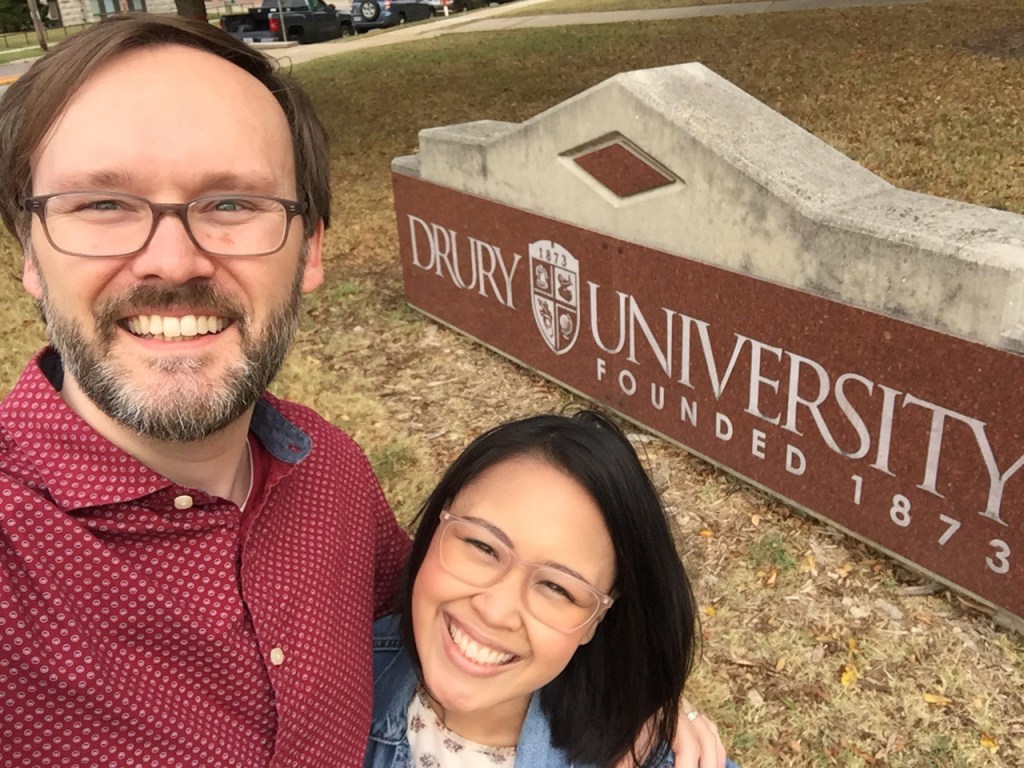
The following is a message I shared in a Drury University chapel service this week. This semester, the theme many of the speakers are exploring is “One Another.” And for anyone reading this who has taken a homiletics class (or four), yes, I realize this message isn’t “balanced” in that it’s extremely heavy on application. On the other end of the spectrum, I hate that I ended up with three points! (I typically go for a more story-like structure that takes you from point A to point B.) Moral of the story: Say the thing God wants you to say through whatever structure communicates it best!

There’s a phrase we often use when we talk about what being a Christian is: “personal relationship with Jesus.” But what does that really mean?

It means we can know Jesus—not just know about Jesus, but we can know Him—personally. We don’t need someone to mediate for us. He’s not distant. He is the God who is with us. One of Jesus’ last words to the disciples before He ascended to Heaven is, “Behold, I am with you, even to the end of the age.” He’s not just with us in an ethereal sense; we have the freedom to approach Him and talk to Him whenever we want. The idea that we can have a personal relationship with God is a distinctive of Christianity. 

The problem with the phrase, “personal relationship with Jesus,” is that we live in an individualist and consumerist culture. And it becomes easy for us to look at our personal relationship with Jesus with me-centered eyes.

Being a follower of Jesus is bigger than “me and Jesus.” Being a follower of Jesus means being part of something bigger than ourselves. 

So here are a couple questions I’d like you to consider: Do people know you have a personal relationship with Jesus? And if they do, how do they know?

  • Because you told them you’re a Christian?
  • Because you post Christian things on social media?
  • Because you go to church or pray before you eat a meal?
  • Or because when they think of you, they think of someone who loves well?

In John 13:34-35, Jesus said:

I give you a new command: Love one another. Just as I have loved you, you are also to love one another. By this everyone will know that you are my disciples, if you love one another.

In Matthew 22: 35-40, Jesus articulated the two greatest commandments:

…an expert in the law, asked a question to test him: “Teacher, which command in the law is the greatest?”

He said to him, “Love the Lord your God with all your heart, with all your soul, and with all your mind. This is the greatest and most important command. The second is like it: Love your neighbor as yourself. All the Law and the Prophets depend on these two commands.”

Isn’t it interesting that these two commands that all of God’s other commands depend on are both relational and social?

In Matthew 5:43-45, Jesus went so far as to say:

You have heard that it was said, Love your neighbor and hate your enemy.  But I tell you, love your enemies and pray for those who persecute you, so that you may be children of your Father in heaven.

Later, in Galatians 5:22, Paul described the fruit of the Spirit—one fruit with nine qualities. And what’s the first quality of the fruit of the Spirit? Love.

What marks us as Christians isn’t our piety, how often we go to church, or even our spiritual disciplines. Those things are important and have their place, but they’re not what marks us as Christians. The mark of being a follower of Jesus is love. 

And as followers of Jesus, love is the thing out of which everything we do flows. 

So I want to spend the rest of this time exploring this question: What does loving one another look like?

This isn’t going to be exhaustive, but I hope to give you a glimpse of what loving one another can look like and to challenge you to love others more deeply.

Loving one another looks like empathy and presence.

The Bible uses a lot of metaphors to describe the Church and one of them is the concept of family. When Jesus taught His disciples to pray, He taught them to open with the words, “Our Father.” He could have taught them to say, “My Father,” but a personal relationship with God isn’t just, “Me and God.” Like I said earlier, having a personal relationship with God means that we can know God personally, but it means more than that. It means that we are members of God’s family. 

This past month, my husband and I were in Alabama to mourn the loss of my father-in-law. Because Alabama is farther along in the vaccine rollout, we were able to hold a service that people were actually able to attend. And it was beautiful to see what kind of people came.

There were people who lived locally whom my mother-in-law hadn’t seen in decades—people who had worked with my father-in-law at the first company he worked at after college. They showed their love just by being there.

And then there was one of my husband’s cousins. To give you some context, my father-in-law was one of twelve, so my husband has a LOT of cousins! We’ve been married for almost 18 years and I still can’t keep them all straight. In fact, there are cousins I haven’t even met yet! Of the cousins my husband actually has a relationship with, there were a number of them we expected to see because they live in the area. But there were a couple that came that were a complete surprise because they had to travel (in a pandemic!) to be there. As we spoke with one of them, he told us what compelled him to make the trip to be there: “These are the cousins I know.” I met this same cousin when Daniel and I got married. He had to travel a far distance to come to that, too. So he has both celebrated with us and mourned with us. 

Loving one another means seeing people where they’re at and choosing to be with them, rejoicing with them when they rejoice and mourning with them when they mourn. Loving one another looks like empathy and presence.

Loving one another looks like living for something bigger than ourselves.

How do we do that? Through our choices. 

The choices we make aren’t just about us. There’s no, “I’m making this choice for me.” Our choices impact those around us. 

Are there choices we make that don’t matter? Sure! A few weeks ago I bought a purse and had to choose whether I wanted the brown one or the black one. Neither one of those choices make a difference in how well I love. 

Now I will say, there was another purse I’d been eyeing for months—stay with me here—but it was way out of my budget. So if I would have bought that other purse, it would have meant less money in the bank. The purse I ended up buying was almost exactly the same as the one I was eyeing except it was a different color and it was 75% off, so I could make it work within our budget. And why does it matter that I made a choice to work within our budget? Because I’ve been wanting to live more generously. And staying within our budget gives us more room to be generous and to love others better. 

A completely unspiritual choice can open up possibilities for spiritual things! 

Our choices—even some that we think don’t really matter—impact those around us.

Last Friday, I got my second vaccine shot. As I was getting it, I started tearing up and said to the nurse, “I’m getting emotional!” And she said, “That’s understandable! You’ve never lived through anything like this before.” And then she said something that made me tear up even more: “Just think about the difference you’re making!”

As we’ve navigated the pandemic over the past year, we’ve seen a lot of opinions about wearing masks, whether or not we should get the vaccine, and a gajillion other things. I’m not here to make a partisan argument. Science is important. The Constitution is important. And it’s okay if we have convictions about those things. It’s okay for science or the Constitution to be a reason why you advocate for something.  But as Christians, the thing that should be our primary, core motivation, the motivation that trumps all others, the thing that most compels our actions…is love.  

You see, if we advocate for science but without love, or if we advocate for the Constitution but without love, we can cause a lot of destruction.

If you study history, it doesn’t take long to see ways that both science and the Constitution have produced some bad fruit and have been used (and at times, manipulated) to justify some awful things, from slavery to the use of atomic bombs.

But when our core motivation is love: 

  • instead of destruction, we create;
  • instead of despair, we bring hope;
  • and in a world that is broken, we bring healing.

Loving one another looks like empathy and presence. It looks like living for something bigger than ourselves. And…

Loving one another looks like allowing God to transform us when it’s hard to love.

Our world is divided. And one of the things that has broken my heart over the past year is to see all the ways that the Church is divided, too.

There’s so much fear, anger, and hate. And I’m gonna to be honest: as a woman of color, it has been a struggle to love. People I disagree with who aren’t Christian? I can love them—easy. But Christians who post racist or misogynistic things on social media, people who marginalize me within Christian spaces and force me to defend the dignity and worth of myself and others who look like me, people for whom I think, “They’re Christians! They should know better and do better!” Not easy. 

I don’t know who you struggle to love, but know that your struggle doesn’t make you a bad Christian—it makes you human. Opening our hearts to love people also means opening our hearts to be hurt by people. And unfortunately, some people do a lot of damage and never repent, never try to be better, never try to fix what they broke, never even say sorry. 

So what do we do about people who are hard to love? We can’t will ourselves to love better! We can’t love our enemies or the people who’ve hurt us without God’s help. 

Start by bringing your honest, unfiltered feelings to God. Don’t hold anything back from Him. If you want to learn how to do that, the Psalms are a great place to start. There’s no human emotion that isn’t expressed somewhere in the pages of the Psalms. God gave space for celebration, joy, and hopefulness. But He also gave space for lament, sadness, discouragement, depression, anger. And if God gave space for those emotions in the Bible, we can know that God gives space for those emotions in us as well. Our emotions—even the dark ones we try to hide from other people—are safe with God. Sometimes we think, “I don’t want to have this emotion, so I’m going to ignore it and pretend it’s not there.” But there’s a better way. You don’t have to hide those things from God. 

When you give God access to those parts of yourself, you also give space for Him to heal and transform you—not with a neat and tidy bandaid, but with true healing. And when we experience God’s healing and transformation, we can truly love. 

So what does this look like? We can pray, “God, I really wish this person or these people would [insert all the dark stuff you don’t want to wish on them but deep down you really do].” And feel safe in the knowledge that God won’t be surprised by any of those thoughts or feelings because He already knows you have them! It’s not about telling God so He can see them. It’s about telling God so you can give Him access to every single part of your heart. And when you’ve laid it all before God, ask Him to do His work in and through those painful thoughts and emotions.

As you pray for people who are hard to love, you might need to start by praying for God to help you to be able to pray for them! 

And then over time, you can try praying for God to change their heart—for them to see the harm they’ve caused and to come to a place of repentance. And maybe one day, you can even come to a place where you can pray for their well-being and flourishing wherever they are.

And even if they never change, you want God to have access to heal and transform the part of your heart that was hurt by them—not to excuse what they’ve done, but so the hurt they caused doesn’t hold you back from being able to love others and to also be able to receive love from others.

Because love is our purpose and calling as followers of Jesus. It’s even our birthright as children of God because we’re not just meant to give it but to also receive it.

So…

Let’s love one another with empathy and presence.

Let’s love one another by living for something bigger than ourselves.

And let’s even allow God to transform us when it’s hard to love.

Fifteen Years Later

img_3221-1
Taken in 2004 when we were still babies.

The day we got married fifteen years ago, we were babies. I was twenty-one; you were twenty-three. At the time, we thought we were so grown up, but now I see how naive we were. Our entire future lay before us: bright and overflowing with possibility. We were going to conquer the world! Not really, but it certainly felt like it.

We didn’t know that our first ministry position would be at a church plant that would fail before it fully launched, that in its final week you would become the lead pastor with the responsibility of shutting it down with dignity. You were amazing; I can’t remember if I ever told you. We didn’t know how bad the situation was until a veteran minister told us that what we went through was the worst he had ever seen. Surely not, we thought. But further corroboration came a decade later when we ran into several pastors who had seen what we went through and each told us the same thing: “We’re so happy you’re still following Jesus.”

When we were in the midst of that ministerial catastrophe, we felt like our lives were over. We had no idea our lives were just beginning.

We didn’t know that in less than a year, we would move to the Philippines and join the pastoral staff of the largest church in the country. (What a turnaround from what we had come from!) Our minds didn’t have the capacity to anticipate how much we would learn, how much we would heal, and how much we would fall in love with a people we never expected to fall in love with. When we eventually left the Philippines to follow the dream we had in our hearts since before we got married, we again felt like we could conquer the world.

We left the Philippines to move to Springfield, MO. Not really. We left the Philippines because we wanted to move to Japan to start a church, but we needed to prepare first. And God wanted us to prepare in Small City, USA. “Five years,” we said. “We’ll live in Springfield for five years and then we’ll move to Japan.” No we wouldn’t.

When we hit the two-and-a-half-year mark, we were halfway done with our gotta-do-before-we-go-to-Japan list. We were right on schedule. And then…

“Daniel, my hands hurt. Look, my fingers can barely move.” After getting a master’s degree in piano performance, we thought my hands were just tired. We had no idea our lives were about to get harder.

Months later you wouldn’t just be my husband; you would become my caretaker. Every morning, you would carry me out of bed and move my legs toward the bathroom because I wouldn’t be able to do it on my own. You would lift my hands over my head to help my arms move as I would scream and cry in pain. It was torture, but it had to be done. It was the only way I would be able to shower on my own. When you weren’t at work, you were spending all your time taking care of me. I could see the exhaustion and worry on your face. Before we went to bed each night, I would cry because I knew the next day we would have to do it all again.

All of this was during your first semester of seminary. When I was in grad school, you supported me. “When you start working on your master’s,” I said, I’m going to support you.” I’m so sorry I couldn’t keep my end of the deal.

When I was diagnosed with lupus, people told me, “Your husband is amazing because he stayed.” This isn’t what you signed up for the day you married me. And yet you stayed.

“But what about Japan?” people asked us, as though God was completely shocked by my lupus diagnosis and had no idea it was coming when He placed the dream for Japan on our hearts. We didn’t know that the first time we would have a chance to minister in Japan, lupus would be the key. I would share my story of God’s goodness amidst suffering. It was Christmastime, so you would talk about Narnia, the darkness of winter, and the coming of spring. And God would do amazing things. We had no idea we would have to wait so long for this dream, but God has been good enough to let us have a little taste.

The excitement of that trip was soon overshadowed by more pain. “This is harder than the failed church plant,” I cried, “This is harder than lupus!” You nodded. You felt it, too. Finding out we couldn’t have children was devastating for both of us.

The day we got married, if I would have known the kind of suffering we would experience, I don’t know that I could have gone through it. I would have looked at all the hard stuff and walked away. But if I had, I wouldn’t have known the profound joy that has blossomed out of each painful experience.

In the months that followed the failed church plant, we found another church in Washington, D.C. where we were surrounded by people who spoke life into our hearts. In that church, God taught us to stand up again. Whenever we go back to visit D.C., I love that we always make a stop at that church’s coffeehouse as a kind of pilgrimage. How fitting that it’s called Ebenezers: “Thus far the Lord has helped us.” And as you sip your coffee and I sip my iced chai, we remember that we’re standing on holy ground, a place where God met us. And when we look back on our lives and remember all we’ve been through, we’re filled with fresh excitement for our future. God brought us this far; He’s not about to stop helping us now!

I’ve heard people say that you don’t really know what love is until you have children. But when you carried me—literally—each morning as we thought I might be dying, you showed me what love is. You showed me a capacity for love beyond what I could imagine. And as we have walked through the deep waters of chronic illness together, you have been my advocate and my champion. When I began to walk on my own again, you cheered for me and made me feel like I had conquered the world. I can’t articulate well the gratitude I feel knowing that I have such an amazing person to celebrate every victory with.

And as we walked through the wilderness of infertility, you refused to let me stop dreaming. I love what we’re doing with our lives now. We’re doing things we probably wouldn’t be able to do well if we had children. We wanted so much to be able to leave behind a legacy. We thought we needed children to do that; God showed us we don’t.

And the cherry on top: you’ve shown me how fun it can be when it’s just the two of us. Five Bookstore Friday dates, late night Waffle House runs, and spontaneous “Ooooh, what’s that? Let’s check it out!” adventures.

When we were young, we wanted so much for God to show us His plan for our lives. We know better now. We don’t really want to see all the stuff that God sees because it would terrify us. We would run the other direction and miss all the good stuff He has for us.

I don’t want to know what’s going to happen next. I just want to keep living this adventure with you.