
Embracing What God Says About Us

pexels-photo-371393.jpeg

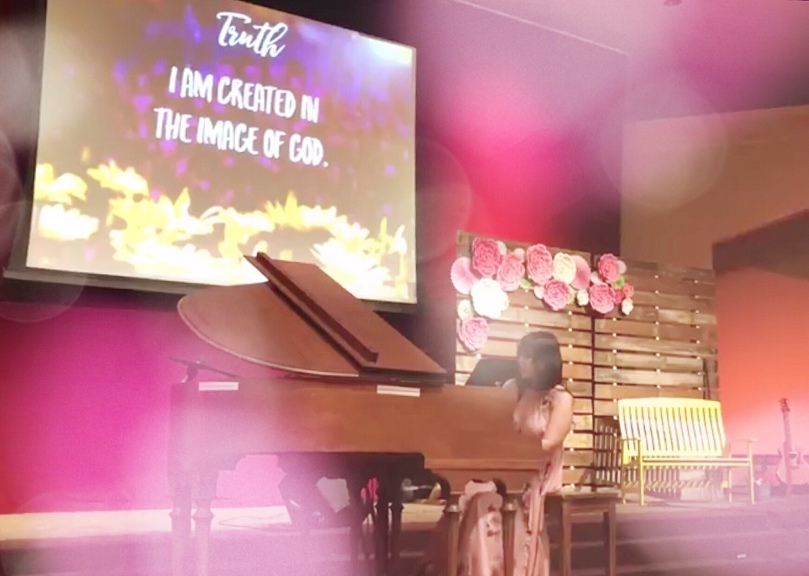
Last Friday, I performed a concert at a women’s event and spoke about the lies we believe about ourselves and that if we want to flourish in our lives, then we must drown out the lies with truth by embracing what God says about usOne of the pieces I performed was Beethoven’s 32 Variations in C minor, WoO 80. Beethoven thought so little of it that he didn’t allow it to be published with an opus number. As I played this piece, projected on the screen behind me were the lies that we believe about ourselves and the truths of what God says about us:
acs_0100

When Beethoven overheard someone playing this piece, he said,

“Such nonsense by me?”

Truth

The 32 Variations in C Minor quickly became popular. It is a masterpiece that is still performed over 200 years later.

Lie

My worth is dependent on how I compare to other people.

My worth is dependent on my performance.

I’m worthless. The world would be better off if I didn’t exist.

I’m not enough.

Truth

“For we are God’s masterpiece. He has created us anew in Christ Jesus, so we can do the good things he planned for us long ago.” (Eph. 2:10 NLT)

Lie

I’m ugly.

I’m too fat. / I’m too skinny. / I’m not the right size.

Truth

I am fearfully and wonderfully made.

I praise you because I am fearfully and wonderfully made;

your works are wonderful,

I know that full well.

(Psalm 139:14 NIV)

Lie

I am defined by my accomplishments.

Truth

I am defined by what Jesus has accomplished.

Lie

I am defined by my past.

Truth

Therefore, if anyone is in Christ, he is a new creation. The old has passed away; behold, the new has come.” (2 Corinthians 5:17 ESV)

Lie

I’ve messed up too badly. My sin is too big.

Truth

No one is un-redeemable. No sin is too big for the grace of God.

“This includes you who were once far away from God. You were his enemies, separated from him by your evil thoughts and actions. Yet now he has reconciled you to himself through the death of Christ in his physical body. As a result, he has brought you into his own presence, and you are holy and blameless as you stand before him without a single fault.” (Colossians 1:21-22 NLT)

Lie

I’m too young. / I’m too old.

Truth

Miriam (Moses’ sister), David, and Mary were not too young to be used by God for great things.

Abraham and Sarah, Elizabeth, and Anna the prophetess were not too old to leave their mark on history.

Lie

Because I’m a woman, I’m less than a man.

I’m overbearing. My emotions are too much.

I’m bossy./I’m not assertive enough. My personality isn’t right.

Truth

I am created in the image of God.

So God created mankind in his own image,

in the image of God he created them;

male and female he created them.

God saw all that he had made, and it was very good.

(Genesis 1:27, 31 NIV)

“The Creator of the universe didn’t just love and speak us into being. He also called us good–the same word He called the massive, majestic oceans and the sun that lights our solar system and keeps us all sustained. (Jess Connolly, Wild and Free)

Lie

I’m not lovable. I don’t deserve God’s love.

Truth

I am loved.

God loves me so much that He died for me.

For God so loved the world that he gave his one and only Son, that whoever believes in him shall not perish but have eternal life. (John 3:16 NIV)

Lie

“But I’ll only be loved if I add value/have something to offer.”

Truth

Love is not about merit; love is about grace.

“This is real love—not that we loved God, but that he loved us and sent his Son as a sacrifice to take away our sins…Such love has no fear, because perfect love expels all fear. If we are afraid, it is for fear of punishment, and this shows that we have not fully experienced his perfect love. We love each other because he loved us first.” (1 John 4:10, 18-19 NLT)

Lie

God has overlooked me. I’ve been set aside.

Truth

I am handpicked by God. I am chosen. I am set apart for a purpose.

“I knew you before I formed you in your mother’s womb. Before you were born I set you apart and appointed you as my prophet to the nations.” (Jeremiah 1:5 NLT)

Lie

I am insignificant and have nothing of value.

Truth

I am an heiress. (Titus 3:7; 1 Peter 3:7)

God is for me. (Romans 8:31)

I am part of a royal priesthood. (1 Peter 2:9)

Lie

I’m not important.

Truth

I’m God’s ambassador.

So we are Christ’s ambassadors; God is making his appeal through us. We speak for Christ when we plead, “Come back to God!” (2 Corinthians 5:20 NLT)

“We have been given great authority through Christ! We’re called to action! And that passage says it’s as if God is making His appeal through us! Ladies, you are not called to sit on your hands in silence. You are called by our great God to run wild into our culture, calling out an incredible message of life: ‘God loves you! World! God loves you and made a way for you! Come with me! You don’t have to live lost and alone! My Dad has a place for you! He sees you as His ultimate treasure!” (Jess Connolly, Wild and Free)

Lie

God doesn’t hear me when I pray.

Truth

“I cry aloud to God,
aloud to God, and he will hear me.” (Psalm 77:1 ESV)

“Since the first day you began to pray for understanding and to humble yourself before your God, your request has been heard in heaven.” (Daniel 10:12 NLT)

Lie

“Am I doing a good enough job at everything I’m doing? It needs to be perfect or else it is not effective. I’m not good enough.” -college student

“I struggled for a long time believing that I was unintelligent. It doesn’t seem to matter how well I did in school, I always felt like I was just getting lucky, or had to work too hard to “get it”, or that I was just a fake.  -a high school teacher who has a PhD

I’m not creative / inspiring / smart / strong enough.

Truth

“Each time he said, ‘My grace is all you need. My power works best in weakness.’ So now I am glad to boast about my weaknesses, so that the power of Christ can work through me. That’s why I take pleasure in my weaknesses…For when I am weak, then I am strong.” (2 Corinthians 12:9-10 NLT)

Lie

I just can’t do what God is calling me to do.

Truth

“My help comes from the Lord, who made heaven and earth.” (Psalm 121:2 NIV)

Lie

I can’t take the next step until I have everything figured out and can see the entire path ahead of me.

Truth

God lights our path one step at a time. He reveals His way as we step out in faith. If you want to see what’s farther ahead, you have to take the next step.

Your road led through the sea, your pathway through the mighty waters— a pathway no one knew was there!” (Psalms 77:19 NLT)

Lie

“God doesn’t see me.”

Truth

I’m God’s treasure, the apple of His eye.

“Our standing has never wavered with our Father. Though the world has twisted what it means to be a daughter, His stance and His position toward us has absolutely stayed resolute.” (Jess Connolly, Wild and Free, p 33)

“I will be a Father to you,

and you will be my sons and daughters,

says the Lord Almighty.”

(2 Corinthians 6:18 NIV)

I am a daughter of God.

pexels-photo-371433.jpeg

Resources to Help You Preach Truth to Yourself

This devotional:

Always Enough, Never Too Much: 100 Devotions to Quit Comparing, Stop Hiding, and Start Living Wild and Free, by Jess Connolly and Hayley Morgan

This book that inspired the above devotional:

Wild and Free: A Hope-Filled Anthem for the Woman Who Feels She is Both Too Much and Never Enough, by Jess Connolly and Hayley Morgan

This little book you can carry in your purse:

Garden of Truth, by Ruth Chou Simons



A Theology of Taking a Nap

pexels-photo-305556.jpeg

Between the end of semester craziness that comes with being a professor and prepping for a big event where I’m performing a concert and speaking, the past month has been non-stop. And then there are the dishes and laundry I can’t keep up with, the pile of books to read for research for my first book, and the pieces I’m learning for upcoming recitals. My life is a bit scattered in different directions and I love it.

But my body and mind have their limits. I’ve been waking up exhausted every morning. My mind has slowed down from all the reading, creating, and memorizing. And as exciting as a lot of the things I’m doing are, I find myself feeling more discouraged than exhilarated.

So on Saturday, I decided to do something I’ve been needing to do for a long time:

I took a nap.

“It is in vain that you rise up early
and go late to rest,
eating the bread of anxious toil;
for he gives to his beloved sleep.”

Psalm 127:2

But how on earth could I possibly take a nap when I have so many things to do? I believe in hard work; the Bible has a lot of harsh things to say about laziness. But this doesn’t give me permission to abuse the body God has entrusted me to steward. I only have one, after all.

But there’s another reason I can rest during seasons of high stress:

“Unless the Lord builds the house,
those who build it labor in vain.”
“Behold, he who keeps Israel
will neither slumber nor sleep.”
I can rest because it’s not all up to me.
We weren’t made to work non-stop. If God has called you to do something for His Kingdom, then it’s too great for you to accomplish on your own. You need divine help from the One who neither slumbers nor sleeps, who has the power to carry our burdens, and can do infinitely more than we can possible imagine.

So if you’re in the midst of a season of weariness, it’s possible that most holy thing you can do is take a nap.

Tearing Down Idols

pexels-photo-158834.jpeg

“When you work on your book proposal, stop reading.”

These words of wisdom were spoken to me by an author I admire during a coaching call. A coaching call that I had prayed about as the scheduled date grew near. A coaching call that I was so excited for that I struggled to fall asleep the night before. A coaching call that melted away my fears about writing my first book and caused faith to well up inside of me. I felt like my life was changing in that hour and I was ready to take all her words and run with them. At least, I thought I was. But amidst all of the wonderful things I didn’t expect her to say, she said the thing I really didn’t expect her to say: “When you work on your book proposal, stop reading.”

I panicked. What?!? Stop reading? What am I going to do? How am I going to make it through a season of high pressure writing if I can’t find rest in my books? I don’t know if I can do it! I need my books!

And that’s when I realized that my books weren’t just objects I loved; they had become an idol.

Books are good. They allow me a chance to be taught by great minds. They give me an outlet to rest and use my imagination. They help me grow as a communicator, artist, and Christian. Books make me a better person.

But at times, I allow them to take too much of my time (and money). I’ve been guilty of turning to a book for help before bringing my problems to God. It’s so easy for me to find my rest in books in place of being still in the presence of the Refuge Himself. And for a brief moment during my coaching call, books were more important to me than being obedient to God’s call on my life.

In the Ten Commandments, it’s not an accident that the first command, “You shall have no other gods before me,” is immediately followed by the command forbidding idols. God is to be first and most in our lives, but we have a knack for turning literally anything into something that dethrones Him from first place.

Where I am living now (a small city in Midwest, USA), carved idols aren’t paraded on the streets like other places I’ve lived. Our idols are more subtle, subjective, personal. Idols can be anything.

“…we do not usually make little statuettes of gold and silver and then worship them. But idolatry knows no cultural or temporal barriers. We have four-wheeled idols whose worshipers spend all their effort and money polishing them and driving them faster and faster. We have three-bedroomed idols, whose devotees have to keep them spotlessly clean in case visitors should come. We have square idols with silver screens. Some of us have well-bound idols with pages and dust jackets.”

(N. T. Wright, Small Faith, Great God)

“We love so many things more than we love our holy and fearful God. We love sports, our stuff, our churches, and our rules. We love our friends, our kids, and our reputations. We love creativity, our homes, and our opinions more than we love God. Ladies, I’ll give it to you straight. Some days I feel like the candles in my house get more praise and devotion and thankfulness than my God gets.”

(Jess Connolly, Wild and Free)

Like my books, it’s so easy to justify our idols, to use their usefulness for good to conceal what we have allowed them to become. But when we peel away the mask, their ugliness comes to light and we see why God would be hard on His people when it comes to idolatry. There is so much God wants for us, but idols get in the way.

Idols are unable to redeem people and situations, to turn mourning into dancing, to make dry bones walk. They keep us from being able to fully experience the Giver of Life and from experiencing the abundant life He intended for us.

Idols cannot answer our prayers, cannot be with us everywhere we go the way God can. God hears and listens to us when we cry out to Him. Even when He is silent and works in ways that confound us, He is still with us, still listening.

The devotion we give to idols robs us of opportunities to hear the voice of God in our daily lives, reminders of how He loves us, divine whispers of ways we can show His love to others.

The things or people we turn into idols are too small to be worshipped. Only the One, Living God is worthy of worship because He created the universe and everything in it; He keeps the Earth, sun, moon, and stars in motion; and He is the One who holds all things together. He cares so much about us that He knows the number of hairs on our heads, keeps count of our tossings, and puts our tears in His bottle. And He loves us so much that even though He knew our hearts would be prone to wander far from Him, He shaped the narrative of the world so that at the perfect time and place in history, He could redeem us. And His history shaping work is nowhere near done. We still have yet to go further up and further in!

When we look at who God is and what He has done, it seems ludicrous to treat Him like He is anything less, to give Him any other place in our lives than first.

So how do we tear down our modern-day idols? By spending more and more time gazing upon the wonderfulness of God.

A Woman’s Highest Calling

pexels-photo-691919.jpeg

She ran to me after church, beaming with excitement. “I wanted to tell you before I told anyone else…I’m pregnant!” (Insert squealing, and hugging, and a flood of happy tears.) This sweet friend of mine had walked the painful road of infertility and made my journey through infertility less lonely. I had prayed desperate prayers for her—the words were easy because I had prayed them so many times for myself—and God heard. She was no longer barren. Now she is a mother.

As I walked out of the church building, the happy tears were no longer happy. Buried emotions welled up inside of me and grief took over. I know that God has been overwhelmingly good to me and has filled my heart with beautiful Kingdom dreams. But during that car ride home, I felt like I had gotten a bad deal. My dreams paled in comparison to the dream of motherhood, and I felt ashamed of them.

As I type this, the absurdity of these words is glaring. The Kingdom dreams bestowed upon me by the Almighty God and Creator of the universe seem like a bad deal compared to motherhood? Absurd.

Struggles with infertility are excruciating. I’ve spoken with women who know pain and hardship, and who speak of how the pain of infertility is greater than anything else they’ve experienced. Infertility crushes dreams and mocks our desires. This is hard enough, but it’s made harder still by a lie that we were taught when we were still young:

“Motherhood is a woman’s highest calling.”

“I see women believing and repeating the lie that motherhood is the highest calling for all women. Did you know that’s nowhere in the Bible? The only reference to a chief call on anyone’s life is found in Matthew 6:33: Seek first the Father’s kingdom and His righteousness. We watch as that lie discourages those who are unable to be mothers and immobilizes those who love their children and still feel called to serve in other contexts. I see broken women believing the only role for them is quiet service and the only pace is nonstop. They exhaust themselves as they serve out of obligation, not worship. I see women believing it’s brash and wrong to seek the wisdom of God, waiting on others to intercede and teach them the Word rather than seeking first the kingdom themselves.”

(Jess Connolly in Wild and Free)

Motherhood is NOT a woman’s highest calling.

Don’t get me wrong. I love my mama friends! Motherhood is an amazing calling—mothers shape the world!—but it is neither the highest nor only calling for a woman. And when we reduce women to whether or not they have children, we minimize the potential God has for their lives.

The world needs mothers.

And the world needs women who are not mothers.

Let’s stop reducing women’s identities to motherhood and empower them to be all that God has called them to be: the daughters of the Almighty God, called to seek first the Kingdom of God and His righteousness and to fulfill big, beautiful Kingdom dreams!

Yet

pexels-photo-631477.jpeg

One of my favorite words in the Bible is “yet.”

yet

ADVERB
Up until the present or a specified or implied time; by now or then.
Still; even (used to emphasize increase or repetition)
In spite of that; nevertheless
CONJUNCTION
But at the same time; but nevertheless.
These three letters are easy to miss. We rush past “yet” to find the “good stuff,” not realizing that “yet” is the good stuff.
“My God, my God, why have you forsaken me?
Why are you so far from saving me, from the words of my groaning?
O my God, I cry by day, but you do not answer,
and by night, but I find no rest.
Yet you are holy,
enthroned on the praises of Israel.”
“O you hope of Israel,
its savior in time of trouble,
why should you be like a stranger in the land,
like a traveler who turns aside to tarry for a night?
Why should you be like a man confused,
like a mighty warrior who cannot save?
Yet you, O Lord, are in the midst of us,
and we are called by your name;
do not leave us.”
“Though the fig tree should not blossom,
nor fruit be on the vines,
the produce of the olive fail
and the fields yield no food,
the flock be cut off from the fold
and there be no herd in the stalls,
yet I will rejoice in the Lord;
I will take joy in the God of my salvation.
God, the Lord, is my strength;
he makes my feet like the deer’s;
he makes me tread on my high places.”

God doesn’t stop being who He is just because life becomes hard. Darkness and suffering don’t negate God; they provide the canvas to make His light and goodness more visible.

So let’s make “yet” part of our anthem:

  • Though what I’m going through is hard, yet God is still good.
  • Though my heart is heavy and I don’t know how I’m going to make it, yet I will live with joy because God is my hope and my strength.
  • Though God seems distant and His silence is drowning the sound of my prayers, yet He is near, He hears my cries, and He’s working in ways my eyes cannot see.
  • Though my life is hard and messy, yet I will keep praising God, holding onto Him, and trusting in Him because He is still an amazing God who loves me and is able to accomplish infinitely more than I ask or think.

“Yet” is the kind of word where the tension between theology and real life thrives. It does not deny the reality of what we’re going through, but it chooses to focus on a bigger reality that our human eyes cannot always see. This word changes our perspective, taking our gaze off ourselves and lifting our eyes to the Almighty God who holds all things together and has the power to redeem people and situations.


Weep With Me,” by Rend Collective

Weep with me. Lord, will You weep with me?

I don’t need answers. All I need is to know that You care for me.

Hear my plea. Are You even listening?

Lord, I will wrestle with Your heart, but I won’t let You go.

You know I believe. Help my unbelief.

Yet I will praise You, yet I will sing of Your name.

Here in the shadows, here I will offer my praise.

What’s true in the light is still true in the dark.

You’re good and You’re kind and You care for this heart.

Lord, I believe that You weep with me.

Part the seas, Lord, make a way for me.

Here in the midst of my lament I have faith, yes, I still believe.

You love me. Your plans are to prosper me.

You’re working everything for good even when I can’t see.

Turn my lament into a love song. From this lament raise up an anthem.

Yet I will praise You, yet I will sing of Your name.

Here in the shadows, here I will offer my praise.

What’s true in the light is still true in the dark.

You’re good and You’re kind and You care for this heart.

Lord, I believe that You weep with me.


What Does Faith Look Like?

winning-motivation-succeed-man-163496.jpeg

“You need to have faith.” Most of the time, I hate these words. It’s not that I don’t have faith or that I have anything against encouraging others to have it, but it’s the context in which these words tend to be spoken to me. When I’m going through a hard season or feel like I’m walking through the great unknown, the words, “You need to have faith,” don’t fill me with faith at all. They make me think, “Isn’t that what I’ve been doing this whole time?” and then I start to feel like I’ve done something wrong. I don’t walk away from these conversations feeling encouraged and empowered. Instead, I walk away feeling deflated and slightly condemned.

Chronic Illness

A few years before I was diagnosed with lupus, I was given a smaller diagnosis. Like most diagnoses, it came at an inconvenient time. I was living in the Philippines and had just been accepted into a graduate program to study piano performance in the States when I found out I had carpal tunnel syndrome and tendinitis in both of my wrists. Over and over again, people told me, “You need to have faith.” What they meant was, “If you want to keep playing the piano and get a Master’s in piano performance, God has to heal you.” I prayed for God to heal me. He didn’t. And I did get a Master’s in piano performance.

It took faith…

  • to pursue a graduate degree in piano performance with carpal tunnel and tendinitis.
  • to choose my repertoire and practice every day.
  • to keep going and not quit when it got hard.

I know that God could have completely healed me and it would have been great, but my 70 minute recital with carpal tunnel syndrome and tendinitis was no less miraculous, no less glorifying to God. But didn’t that make it harder? Yes. I’ll get more into that later, but I’m getting ahead of myself…

When I was diagnosed with lupus, I heard it again: “You need to have faith.” What people meant was, “You need to be completely healed of lupus to be able to fully live your life. And if you aren’t healed, then you must not have enough faith.”

It takes faith…

Speaking of the future…

A Dream Delayed

Ever since we were in college and still dating, my husband and I have dreamt of moving to Japan to start a church. It’s something we feel God has placed on our hearts. But even though we’ve been on a missions trip to Japan, we have yet to move there. There are things that we feel God has asked us to accomplish first—that’s why we moved back to the States—but lupus has caused those things to take much longer than we anticipated.

It takes faith…

  • to keep moving towards this goal, even when things feel slow.
  • to keep studying Japanese.
  • to remember that God was not surprised when I received my lupus diagnosis and knew about it years ago when He placed the dream for Japan on my heart.
  • to trust in God’s perfect timing and to rest in the fact that He is in control.

Unanswered Prayer

I’ve spoken about my infertility in other posts, so I won’t retell those stories here. What I will say is that unanswered prayer—no matter the subject matter—is painful. It fills us with the darkest of doubts and questions. Why didn’t God answer my prayer? Did I do something wrong? Does God really love me? Is God really who I thought He was? It’s in the midst of unanswered prayer when people’s statements of “You need to have faith,” are most painful to hear. Haven’t I been having faith all along?

It takes faith…

  • to hope and pray when the doctor says words like, “zero percent chance.”
  • to pray to God after being wounded by unanswered prayer.
  • to continue to believe that God is good and that He is not withholding good from me.
  • to choose to live with hope and purpose when you feel like your hope and purpose have been crushed.

The Truth About Faith

“And what more shall I say? For time would fail me to tell of Gideon, Barak, Samson, Jephthah, of David and Samuel and the prophets— who through faith conquered kingdoms, enforced justice, obtained promises, stopped the mouths of lions, quenched the power of fire, escaped the edge of the sword, were made strong out of weakness, became mighty in war, put foreign armies to flight. Women received back their dead by resurrection. Some were tortured, refusing to accept release, so that they might rise again to a better life. Others suffered mocking and flogging, and even chains and imprisonment. They were stoned, they were sawn in two, they were killed with the sword. They went about in skins of sheep and goats, destitute, afflicted, mistreated—of whom the world was not worthy—wandering about in deserts and mountains, and in dens and caves of the earth. And all these, though commended through their faith, did not receive what was promised, since God had provided something better for us, that apart from us they should not be made perfect.” (Hebrews 11:32-40)

Did you catch that? Hebrews 11 has been nicknamed the “faith chapter” of the Bible. If you want to know what faith looks like, this is where you look. So. Many. Miracles. And also weakness. And torture. And imprisonment. Oh, and also people who were destitute, afflicted, and mistreated. The life of faith isn’t as neat and tidy as many would have us think. In fact, if faith were easy, it wouldn’t be faith at all.

We do need faith, but not because God has called us to a life of comfort and ease. We need faith because life is hard.

So let’s get real for a moment. When the object of our faith is faith itself, it falls apart when things don’t go our way. But when the object of our faith is the God who is sovereign, loving, and good, then it can be subjected to hardships and still continue to stand.

Before you keep reading, I want you to pause and ask yourself this question: Is your idea of what faith looks like so narrow that it leaves little room to be surprised by God and to notice when He works in mysterious ways?

Too often we try to make the works of God fit into a box too small to contain Him. We think that when faith looks like x, God will do y. God’s ways are too creative and too wonderful for our preconceived ideas!

The God Who Can Do Anything. Literally.

Could you imagine what would happen if we believed God could do anything?

Let me give you an example of what I mean by anything.  Let’s say someone you know is sick. Do you believe God can do anything so He can heal them? That’s great! But believing God can do anything doesn’t stop there. He can heal how He wants and when He wants, and no matter how God decides to work, it’s going to be good and amazing, and even if He chooses to wait and doesn’t heal someone on this side of eternity, He can make them strong out of their weakness and use them to be the catalyst for a myriad of more amazing miracles that can change the course of history. God can do anything!

I hope that you’re getting really excited right now because I’m getting excited just typing this! If we can live with this kind of faith, can you imagine the kind of faith we can inspire in others? When people spend time with us, instead of walking away feeling discouraged about their lack of faith, they could walk into the great unknown full of faith, believing and expecting God to do anything!

So enough with telling people, “You need to have faith.” Let’s fill people with excited expectancy and say, “What if the God who is sovereign, loving, and good—the God who can do anything—is preparing to do something infinitely more amazing than we can imagine?”

This is the kind of faith that can change the world!

Let’s Talk about Theology

pexels-photo-433104.jpeg

I’ve been doing research for a big project and that means that I get to read books galore!!! (If you’re into the Clifton Strengths Finder test, my second top strength is intellection. My personalized strengths insights report said, “It’s very likely that you derive much satisfaction from reading books…” So, yeah. I LOVE books.) My husband, who shares my obsession, helped me pick books for my research. He wrote down titles by authors like C.S. Lewis and N.T. Wright.

And then there was one title he wrote down with a note: “Skim this. It might be helpful.” It was a book that talks about God helping us when we’re going through tough circumstances. I’m not going to name the book or author, but I’ll sum up one of his main ideas for you: Just trust Jesus; theology isn’t that important.

As the author proceeded to disparage theology, I wanted to shout, “You don’t understand what theology is!” As the great Inigo Montoya said, “You keep using that word. I do not think it means what you think it means.”

Theology, simply put, is the study of God.

How can we trust God if we don’t know whether or not He’s trustworthy? And how can we know He’s trustworthy if we don’t even know who He is? The people we trust most aren’t strangers or mere acquaintances; the people we trust most are the ones we know well. In shallow relationships, trust is unsustainable. If you want to be able to trust God, to be able to feel secure in Him when your world is falling apart, you need to know who He is, what His character is like, and what He is capable of doing. This, my friend, is what theology is for!

In The Great Omission, Dallas Willard wrote, “In the case of theological integrity and spiritual vitality, I think the idea is that you really can’t have the one without the other.”

Theology is not about having all the answers and knowing it all. The best theologians are brilliant, but not because they know it all. They’re brilliant because the more they study, the more they realize how much more there is to know about God, so they dig deeper and study more, and the cycle continues. We could never know everything about Him because He’s just too big and wonderful. And He’s SO wonderful that the more you study and the deeper you dig into who He is, the more you want to know more!

Theology is about knowing God—a God who is infinitely more than we can comprehend, yet who still invites us to know Him—to know Him deeply, and to continually seek Him so we can know Him deeper still. The deeper we know Him, the deeper our roots grow deep into who He is.

So how do we get to know God? Do we have to have graduate and post graduate degrees to have strong theology? No. Please don’t misunderstand. I’m not against higher education. I have a master’s degree and my husband is in seminary right now. But strong theology is not reserved for only those with multiple degrees. Strong theology is cultivated by dwelling in God’s presence + digging deep into His word + being part of Christ-centered community. All three of these are things that every Christian can do!

“Therefore, brothers, since we have confidence to enter the holy places by the blood of Jesus, by the new and living way that he opened for us through the curtain, that is, through his flesh, and since we have a great priest over the house of God, let us draw near with a true heart in full assurance of faith, with our hearts sprinkled clean from an evil conscience and our bodies washed with pure water. Let us hold fast the confession of our hope without wavering, for he who promised is faithful. And let us consider how to stir up one another to love and good works, not neglecting to meet together, as is the habit of some, but encouraging one another, and all the more as you see the Day drawing near.”

Hebrews 10:19-25

One day I’m gonna write a book where I delve deeper into all of this, but for now, please allow me to give you the short version:

It’s so important for us to dwell in God’s presence—to have an intimate relationship with Him—because He’s a relational God who cannot be known from afar. You can know about Him from afar, but to know Him, you have to get up close, spend time with Him, and experience His presence first hand.

It’s also important for us to dig deep into His Word because experience alone with no knowledge or understanding is fragile (and can lead to a lot of weird or dangerous beliefs!). We need truth to be our strong anchor.

Originally when I was writing this, my formula stopped here, but my husband pointed out that we need Christ-centered community. “It’s like a three-legged stool that falls if one of the legs is missing,” he said. It’s when we’re together when we can see outside of ourselves. Together, we see bigger, farther, and deeper. We help each other see and understand God in ways we wouldn’t be able to on our own.

If we neglect any of these components, we’re in danger of having an incomplete, shallow theology. And shallow theology crumbles in the face of suffering and doubt.

You see, having strong theology doesn’t mean that we never have questions or doubts. Instead, strong theology survives in the face of our hardest questions and our most painful doubts because it’s rooted in a God who is strong enough to handle them. Strong theology gives us roots in who God is that are so deep that even when the storm rages against us, we do not fall. 

Theology in Real Life

During a painfully dark season of my life when I felt barren and struggled to pray, I had coffee with a dear friend who tenderly gave me wonderful advice: When it’s hard to pray, start with simple, truth statements like, “God is good,” and pray something like, “God, You’re good. Help me know you’re good.”

Did you catch it? All three components of strong theology were there!

Dwelling in God’s presence (prayer)

+ digging deep into His word (simple truth statements)

+ being part of Christ-centered community (coffee with a friend)

This is what theology looks like in a real life! And I love how my friend’s advice is so simple and accessible, yet full of depth! I mean, yeah, “God is good” is one of those statements that can seem overly simplistic, but for those who are suffering or are feeling the sting of unanswered prayer, the statement, “God is good,” becomes far more profound, a statement to wrestle with God about. If you’re in a season of suffering or doubt and need more theological statements you can pray, here are some to get you started:

“Jesus loves me.”

“God is for me.”

“God is bigger than me and my circumstances.”

“God’s grace is sufficient for me.”

“God is not withholding good from me.”

“What’s true in the light is still true in the dark.” (This one’s a line from “Weep With Me,” by Rend Collective.)

If you’ve been intimidated by theology, let me end with a word of encouragement: You can do this! You can do theology! I know you can because God wants you to and He provided a way for you to be able to! So let your roots grow deep into who He is and get ready for an adventure of living theology in real life!

Trying to Pray

pexels-photo-594421.jpeg

As I slowly pulled my tired body out of bed, I felt it again. Overwhelming sadness. It was the same sadness I had been feeling every day for months. I remember the exact moment this sadness became a part of my life: the moment after waiting several minutes to discover that the strip did NOT turn blue. After surgery, many months of infertility treatment, and “pouring out my soul before the Lord” (1 Samuel 1:15), I was not pregnant.

It was a hard enough blow to learn that, yes, I truly am incapable of bearing children. But it was excruciating to find out when I did: the Tuesday before Mother’s Day. It was like some sort of sick, cosmic joke. Any time I turned on the television, bought groceries, or did anything, “Happy Mother’s Day” everything scraped against my fresh wounds.

I think this would be a good time to explain that I’m a Christian and I believe in a God who hears our prayers and is able to work miracles. Many months prior to the strip not turning blue, my doctor told me I had a zero percent chance of getting pregnant. But I was about to have surgery, and that meant there would be hope. We had been down this road years before. Surgery, followed by hope, followed by disappointment. But this time, we had a plan to increase the probability of getting pregnant after surgery from a “zero percent chance” to a “slight chance.” And I laid my “slight chance” before God in a series of intense prayers drowned in a thousand tears. I was full of faith and, at the same time, willing to accept what God’s will may or may not hold. I begged Him to make my longings to bear a child go away and to not let me go down this road if motherhood wasn’t at the end of it. I prayed for wisdom and guidance. I prayed for Him to help me stay obedient to His will. And after weeks of praying like this—and the longing for motherhood ever persisting—I prayed for a miracle.

And I was disappointed.

For months, I lived with a label seared into my heart. “Barren.” My body was unable to carry and nurture life. I was not dead, but I no longer felt alive. My life had become a bare wilderness. Dry and lonely. I felt broken, purposeless, useless, and like a failure as a woman and wife.

I wish I could say that in those months, I fervently sought the face of God and clung to Him. I tried to, but I just couldn’t. On a good day, I would pick up my Bible, set it back down, and pray, “I can’t today, God. I’m sorry.” Some days I could actually open my Bible and read a paragraph before whispering, “God, this is all I can read today. Thank You for your grace. Please help me.” Most days, my Bible remained untouched and no words came, only deep wailing and tears. It’s not that I didn’t want God; the pain was too overwhelming. I could barely pray even when I went to church; I mostly just sat in my pew and cried.

In the midst of all of this, God was silent. It was through this season of silence and wilderness that I learned that when we’re unable to cling to God, He clings to us. And when He clings to us, that is enough. At times, He doesn’t use words because He knows some wounds are too deep for words. He knows exactly what we need: we need Him to be there. And He is.

After a long season of silence, I began to hear God’s still, small voice again. When I prayed, “I can’t today, God. I’m sorry,” He would respond, “That’s ok.” Two words. Months of silence were followed by barely anything. But when you’re desperate, “barely anything” is just the lifeline you need. And slowly, it became easier to pray my tiny prayers.

Then one day, I was done. I was done praying badly. I was done feeling the same overwhelming sadness again and again. I was done being in this wilderness. So in the early hours of morning—so early that even the sun was still in bed—I woke up, dragged my sleepy body to the living room, and opened my Bible. When I started reading, I felt nothing. But I forced myself to engage, circling words, underlining phrases. And when I finished, I prayed. I mean, really prayed with ugly tears. I was determined to pray until…until. And after asking all my “why” and “how long” questions, I said what had been brewing in my heart for so long:

“God, You really disappointed me.”

Those words had been pent up in my heart for so long that when they came out, they kept coming out again and again. Loudly. It was like a wrestling match; and if volume and tears were points, I was winning. “God, You really disappointed me! You disappointed my husband! I told You I didn’t want to go through all of this if it didn’t end in motherhood and YOU DISAPPOINTED ME!” And I kept going until I felt like I got it all out. Then after some moments of silence, God answered. Not with condemnation or guilt, but with these words: “Read the passage you read earlier again.”

“Blessed be the God and Father of our Lord Jesus Christ, the Father of mercies and God of all comfort, who comforts us in all our affliction, so that we may be able to comfort those who are in any affliction, with the comfort with which we ourselves are comforted by God. For as we share abundantly in Christ’s sufferings, so through Christ we share abundantly in comfort too. If we are afflicted, it is for your comfort and salvation; and if we are comforted, it is for your comfort, which you experience when you patiently endure the same sufferings that we suffer. Our hope for you is unshaken, for we know that as you share in our sufferings, you will also share in our comfort.” (2 Corinthians 1:3-7)

And after I read those words, God drowned my wilderness and flooded me with His comfort.

The Father of mercies and God of all comfort turned my barren wilderness into a river.