I was once at a church thing where a speaker talked about the Hebrew words for praise. At the end of their message, they gave us an opportunity to practice doing each of those words. (Before you read on, I want you to know that I’m not throwing any shade to this speaker at all. And just in case, I’m also not going to tell you who they were. If you want to try to guess, know that I’ve been in many services in more than one country in which speakers have given basically the same presentation. So maybe I’m amalgamating multiple speakers into one; maybe I’m not. 😜 Anyway, back to what I was saying…) One of the Hebrew words for praise is towdah. The translation this speaker gave for towdah was, “to extend the hands with thanks for promises that are coming,” and the Scripture cited was Psalm 50:23.
"Whoever sacrifices a thank offering honors me,
and whoever orders his conduct,
I will show him the salvation of God."
(Psalm 50:23, CSB)
Even though I had heard all of this many times before—and had even taught it myself a few times—I listened and took careful notes. And when it was time to practice praising God in different ways, I “knew the drill” and was ready to go. But when the time came to “thank God for promises that are coming,” I couldn’t do it and I sensed the Holy Spirit speak a loud, “no,” into my heart. “You can’t do this yet,” He said. It may seem strange that God would tell me not to praise Him yet. But I had a suspicion for why and decided to check it. So as the sound of people praising surrounded me, I pulled out my Bible and read the passage again—not as an isolated verse, but as a part of a whole—beginning with verse one.
It’s important to remember that the book of Psalms was/is the Jewish prayer and song book. And for Christians today, it’s still meant to be our prayer and song book, giving us language to fully express our hearts to God. And whether we’re reading the Psalms or any other book of the Bible, when we isolate verses from their context, we misunderstand what those verses mean.
So now let’s take a look at Psalm 50. Many words of this psalm would not be suitable to stitch onto a throw pillow:
"Our God is coming; he will not be silent!
Devouring fire precedes him,
And a storm rages around him."
(Psalm 50:3, CSB)
When someone in the Bible spoke or prayed about God not being silent, there was something they wanted God to respond to. And that something was likely a source of pain, anger, or some other heavy emotion. What (or who) was causing this author to cling to God this way in this psalm? From verse 7, we learn that the offenders were God’s people. (“Listen, my people, and I will speak; I will testify against you…”) These were people who had God’s law and knew what He required of them. In today’s vernacular, we’d say these people went to church, raised their hands and voices during worship, and they might have even been the loudest and most verbose during prayer time. But God rejected their acts of worship and called them “wicked.” Why?
"But God says to the wicked:
'What right do you have to recite my statutes
and to take my covenant on your lips?
You hate instruction
and fling my words behind you.
When you see a thief,
you make friends with him,
and you associate with adulterers.
You unleash your mouth for evil
and harness your tongue for deceit.
You sit, maligning your brother,
slandering your mother’s son.
You have done these things, and I kept silent;
you thought I was just like you.”
(Psalm 50:16-21, CSB)
In short, Psalm 50 expresses pain and anger about those who outwardly worship God and claim His name, but who also participate in injustice.
You cannot do the praising of Psalm 50:23 until you have done the lamenting and petitioning of Psalm 50:1-22. There is no shortcut to praise. It’s not that God doesn’t know about our pain unless we express it; it’s that by expressing our pain to Him, we give Him access to it so He can do His transformative work in and through it. God does not ask us to bypass our pain; the God Who Is With Us invites us to walk with Him through our pain. And while we still live in the now and not yet, in a world that is still broken and yearning to be made new, we continue to both lament and praise.
So back to the day when a speaker invited a room full of people to praise God for the promises that are coming: After the Spirit told me, “No, you can’t do this yet,” I broke into tears and lamented, giving voice to injustices I had seen and ways I had been wounded. And after I lamented and poured out my heart to God, I was able to praise.
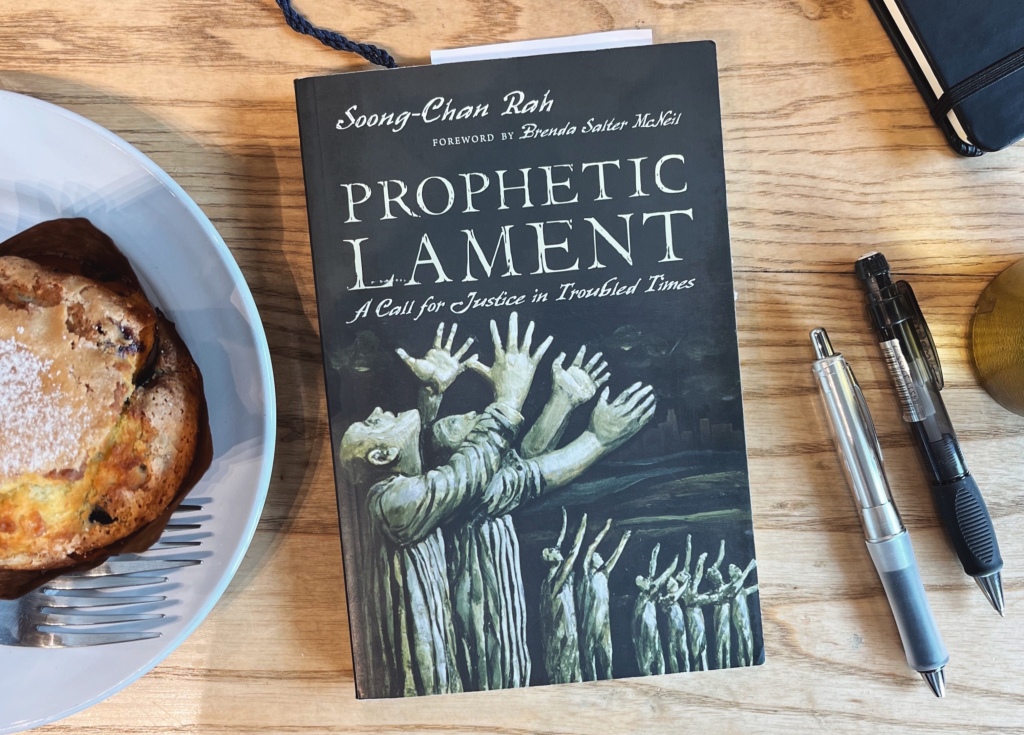
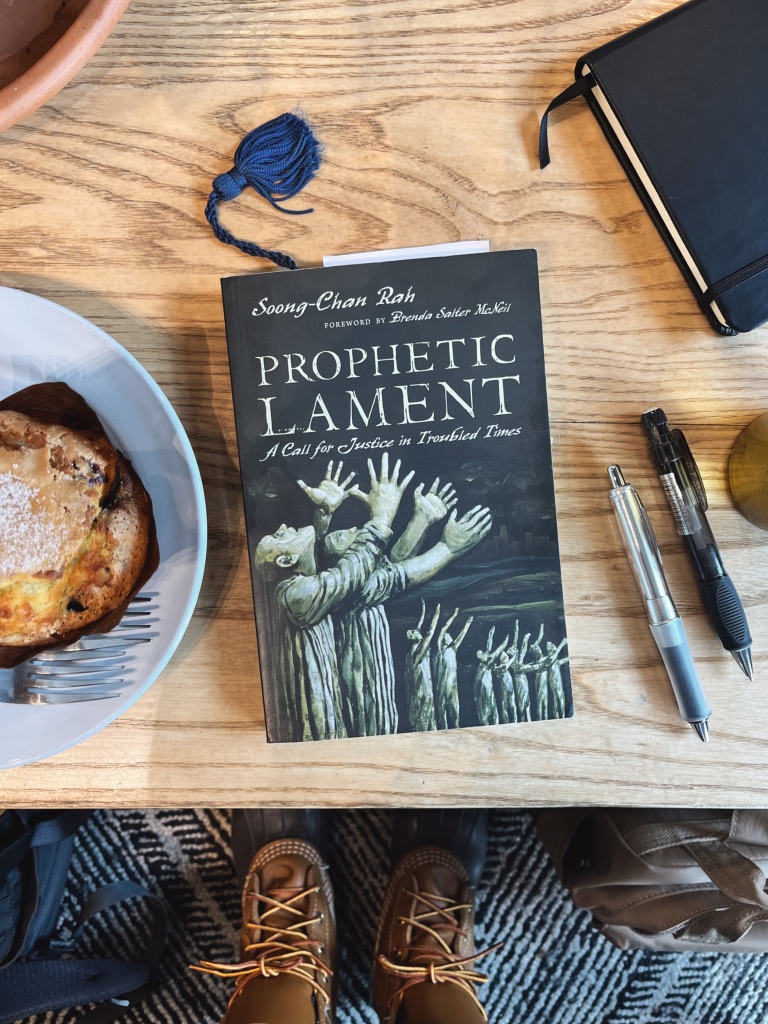
“There is power in bringing untold stories to light.”
“Lament serves the purpose of providing a necessary step toward praise.”
“What would happen to our faith if we believed that God reigns sovereign over both our celebration and our suffering?”
“Lamentations recognizes that individual voices from the full range of citizens must be heard. Lament requires the full and honest expression of suffering; that experience must encompass the full breadth of suffering. In contrast, American evangelical Christianity often presents only the story of the dominant culture. Often, the stories from the ethnic minority communities are not deemed worthy…The power of Lamentations is that the voices of those who have actually suffered are not missing.”
“In many of our justice endeavors, we often believe that our task is to speak for the voiceless. But maybe we need to follow the book of Lamentations and move the ones who suffer to front and center. The prophet-narrator has much to say, but the real movement and progress is that we hear the actual voice of those who suffer.”
There are SO MANY Bible study tools available. And among them are a lot of great resources as well as a lot of…um…not so great ones. So if you don’t know what you’re looking for (or maybe even if you do), navigating the sea of accessible Bible study tools can be overwhelming. So I thought I’d let you see some of my go-tos. Please note that even though I tried to keep this list short and simple, it can still seem like a lot if you’re just getting started. So after getting a Bible, if you want to start with just one thing, skip to the very end!
My Go-To Bibles:
First things first. The most important tool when you’re studying the Bible is…a Bible.
She Reads Truth Bible – There are a lot of Bibles in my home in a vast array of translations, languages, and editions. But when I’m sitting down to spend time with Jesus, this is the first one I grab. It has helpful resources in it (devotionals, charts, timelines, etc.) but not so much that I get bogged down in overthinking mode. In other words, it has a clean design and doesn’t look like a textbook. It also has wide margins, so it’s a great journaling Bible. (Random fun fact: one of the devotional writers is Jill McDaniel. Who’s Jill McDaniel? She goes to my church and she’s my friend. Also, she’s awesome.)
He Reads Truth Bible – I love my SRT Bible so much that I bought my husband the HRT Bible when it came out. Unlike the SRT Bible, the HRT Bible doesn’t have any devotionals in it. BUT, it does contain more resources (charts and such) that they developed after making the She Reads Truth Bible. Because of that, it’s not uncommon for me to borrow my husband’s Bible.
ESV Study Bible – This is pretty much the gold standard of study Bibles! It’s what I go to when I want to get into the nitty gritty. Its pages contain a wealth of diagrams, charts, notes, and a whole lot more. (Something to keep in consideration is that many of the notes in this study Bible are written from a more Reformed perspective. If that’s a turnoff for you, I list another great study Bible below.)
Digital Bibles:
Bible.com – This is a free digital Bible website and app. I mostly use this when I’m on the go or when I’m looking up passages in multiple versions. (I also link to Bible.com whenever I quote passages in my blog. 😉 ) The She Reads Truth app and He Reads Truth app are also great digital Bible options.
Since words—especially words in the Bible—don’t always mean what we think they mean, here are a couple websites where you can click/tap on a word in a passage and find out what it means: NetBible.org and BibleWebApp.com.
Bible Background Resources:
Cultural Backgrounds Study Bible – I didn’t list this under the “My Go-To Bibles” category because I only have this Bible in Kindle format, so I mostly use it for the articles. If you don’t already have a study Bible, I highly recommend this one! (I link the NIV below, but it also comes in NKJV and NRSV.)
To be honest, I don’t use the Cultural Backgrounds Study Bible as much because the following two books are my go-to for historical and cultural background deep dives.
John Walton and Craig Keener, the writers for the notes in the Cultural Backgrounds Study Bible, are the same people who wrote these commentaries. When I read these commentaries, I often find myself exclaiming out loud, “What?! This passage makes so much more sense now!”
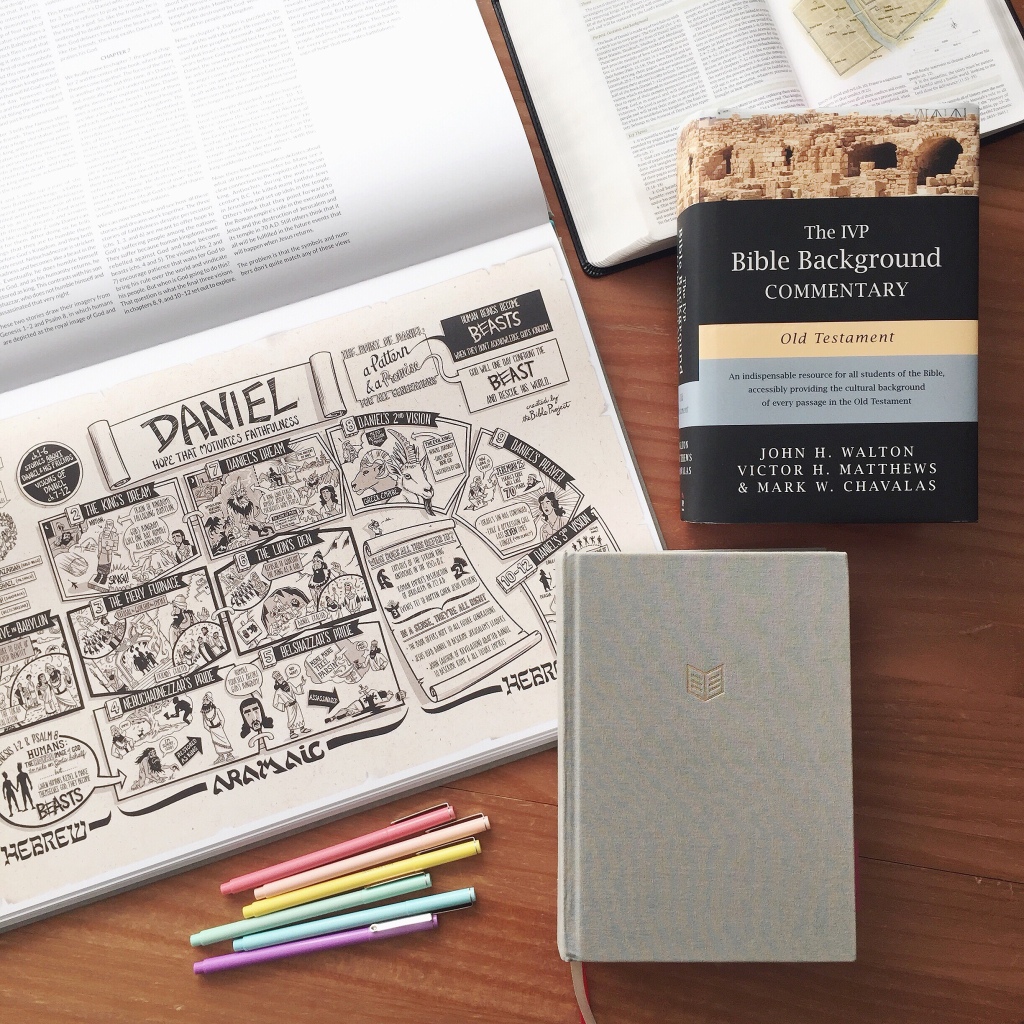
The IVP Bible Background Commentary: Old Testament
The IVP Bible Background Commentary: New Testament
A note about commentaries for Biblical studies and ministerial students: I use a lot more commentaries than what I list here. I’m not going to list any of them here, because the point of this post is to give people who are beginning to study the Bible a starting point. Which commentaries are best? It depends on which book of the Bible you’re studying and what you’re looking for in a commentary. So when you’re picking commentaries, do your research and use more than one source when you can (libraries can help!).
If I Had to Pick Just One to Get Started:
BibleProject.com – From the BibleProject website: “BibleProject is a nonprofit animation studio that produces short-form, fully animated Bible videos and other Bible resources to make the biblical story accessible to everyone, everywhere. We create 100% free Bible videos, podcasts, and Bible resources to help people experience the story of the Bible.”
I love BibleProject so much that I got their ginormous coffee table book that has all the diagrams and summaries from the videos for each book of the Bible.
Honestly, I could spend hours just sitting and watching BibleProject videos. They have so much to explore! But when it comes to my regular Bible study, what do I do with these BibleProject resources? Before I begin reading a book of the Bible, I like to watch the corresponding video that “outlines its structure and design and how it fits into the entire biblical story.” And then I like to keep the coffee table book open close by so that if I feel like I’ve lost where I am in the larger story—especially when I’m reading a particularly lengthy book—I can glance up and get my bearings.
Okay, so I told you some of my go-tos. What are some of yours?
Our lives have been interrupted, but this is a time when we can focus on the things that matter most, a time for growth and beauty. So for each day in the next 2 weeks, I’m giving you something you can read or listen to—a blog post, podcast, recording, book—that can help you slow down and go deep in some way.
Something I’ve been cultivating is a rule of life, a rhythm of spiritual disciplines. These next couple of weeks are a great time to lean into it even more! If the idea of a rule of life is new to you, here’s something I wrote a couple months ago to give you some ideas to help you start your own.
For such a time as this, technology and the internet are a blessing. If you don’t have a church home (or if your church doesn’t have the capabilities to do online streaming of services), you can check out my church’s YouTube channel. (Bonus: my pastor’s a rocket scientist! I’m not kidding!)
This podcast is for women running on mission. These episodes aren’t your typical “You got this!” messages. They are a beautiful, weekly dose of depth + practicality + encouragement.
If you and I were to sitting down for coffee, it wouldn’t take long before the topic of the Enneagram came up. I LOVE talking about the Enneagram!
Why? Because I love getting to know people and understanding them at a deeper level. But here’s the thing: I naturally put people into a box of what my own personality looks like and I struggle to see things from other people’s point of view. The Enneagram helps me “get” people better.
If you want to learn more about the Enneagram, there’s a plethora of great resources out there and it can get quite overwhelming trying to figure out where to start. So to help you out, here’s a list of some of my favorite resources.
Website
The Enneagram Institute – If you don’t know where to begin, this is the perfect place to start. This site has easy-to-navigate descriptions of the nine types. It also has a reliable and affordable test if you’re struggling to figure out which type is yours.
The Path Between Us – I personally enjoyed this book more than The Road Back to You because it deals with our relationships with others. The book description on its Amazon page says, “Most of us have no idea how others see or process their experiences. And that can make relationships hard, whether with intimate partners, with friends, or in our professional lives. Understanding the motivations and dynamics of these different personality types can be the key that unlocks sometimes mystifying behavior in others―and in ourselves. This book from Suzanne Stabile on the nine Enneagram types and how they behave and experience relationships will guide readers into deeper insights about themselves, their types, and others’ personalities so that they can have healthier, more life-giving relationships.”
The Sacred Enneagram – I’ve never felt more seen than when I read this book. I will probably read this book again and again throughout my lifetime.
Sleeping At Last – It may seem weird to have a music section on a post like this, but I can’t leave out Sleeping At Last’s enneagram-based songs. The music and lyrics of each of these songs are carefully crafted to reflect of the types in a way that words alone cannot.
Stuff for Your Home
All Good Things Collective Enneagram Line – The thing I love about these prints and canvases is that they have two for each type—one that focuses on each type’s strength and one that focuses on each type’s weakness.
If you’re wondering why I didn’t list any podcasts, it’s because I don’t listen to podcasts much. I don’t have anything against them, I’m just not a podcast person.
What are your favorite Enneagram resources? Tell me in the comments. 🙂



 Esther Guy