My name is Esther. I was named after a White, American, Assemblies of God missionary. She was the pastor’s wife at the church in the Philippines where both my parents were saved and got married. My father grew up in this church. His mother, Nanay Ching, was one of the founding members when this church was planted in the 1950s by an American missionary. Nanay Ching became the church’s head treasurer. She was a pillar of the church, a prayer warrior, called a mother by all who knew her.
When I was a little girl, I have a memory of both Nanay Ching and the Esther for whom I was named visiting my family in Chicago. Standing outside my church after the Sunday service, these two mighty women of God held hands and my grandmother said to me, “This is my best friend.”
I’m as AG as one could get: I went to kids camp where I was filled with the Holy Spirit with the physical evidence of speaking in tongues. I went to youth camp where I experienced the call of God to be a preacher of the Gospel. I did Teen Bible Quiz, memorizing the book of John, yet scoring badly in meets. I won Fine Arts twice. I graduated from Central Bible College with a degree in Preaching and Evangelism. Because music is one of my favorite languages with which to declare the mysteries of the Gospel, I got a master’s degree in piano performance. And though the many hours of practicing was brutal on my hands that were already showing signs of lupus before I knew I had lupus, I still played on the worship team at my AG church on Sundays and Wednesdays. Whether I found myself in a church or college campus, I’ve been obedient to God’s call on my life. Today, I’m on staff at a campus ministry at Princeton University. All because of an Assemblies of God missionary who started a church in Manila, Philippines and the Assemblies of God missionaries who continued that work.
Somewhere in the midst of my life story, my husband and I ended up moving to the Philippines to join the pastoral staff at that church. One day one of the pastors I shared an office with was rummaging through one of the closets and shouted, “Oh, Pastora Esther! Look! It’s your video!” A VHS tape my dad made with a compilation of my performances and preaching, sent to my grandmother, made its way into the hands of the pastors of that church.
That church is no longer an Assemblies of God church. The story, which happened decades before my time there, is tragic and sad. I don’t know all of the details, and the details I do know are murky. But I do know that when we would visit my grandmother on our days off, she would say, “You’re Assemblies of God?”
“Yes, Nanay Ching. We’re Assemblies of God.”
And she’d lower her head and close her eyes as she’d say, “The Assemblies of God tried to steal from us.”
I do believe a lot of good changes have been made at an institutional level to not repeat some of the sins of our fellowship’s past. But there’s still something sinister lurking in the shadows, silently seeping into the handiwork of good intentions mixed with unexamined colonialism and paternalism.
I experienced it as a youth when a friend and I were invited to perform at a district council. My pastor introduced our families to some ministers and said, “Our church has a lot of ethnicities.” That statement filled me with pride, but I remember feeling uncomfortable as they gawked at us like we were oddities. And I guess, in light of what the people in the rest of the room looked like, we were.
I experienced it in Bible college when a number of my peers told me I needed to learn how to act more White.
I experienced it when my home church did a missions trip to the Philippines, a trip that would be especially meaningful to the Filipino-Americans going on that trip. Before that trip, the missionary visited our church to do a training for us. After the training, all of us (including the missionary) were invited to a party at someone’s house. My Filipino-American friends and our immigrant parents were horrified as the missionary participated in the karaoke, singing with a mocking, over-the-top, Filipino accent.
I experienced it when a missionary in residence at my Bible college said in front of the class, “This is how all Eastern people think. Right, Esther?” And then when he tried to explain to me how I think when I was stunned to silence.
Missionaries have been the most likely to doubt I’m fully proficient and fluent in English and to assume my husband met me when he was “ministering to me” in the Philippines. They struggle to believe my husband and I went to Bible college together (in America!) and graduated with the same degree.
I wish I could believe all ministers and missionaries always know what the people they minister to need most and what communicates dignity to them. I know many for whom this description is accurate, wonderful mentors and close friends for whom I’d take a bullet because they’ve loved me so well and I love them so. There’s one youth pastor—a lead pastor now—I feel especially indebted to. He took time to teach me homiletics (the art of preaching) when I was fifteen. He mentored me and took risks in giving me responsibilities. He helped carry my burdens and taught me by example what it means to love and pastor. And he pushed me to dig deeper and think more critically about Scripture. I honestly don’t think I’d be where I am today without his deep impact on my life decades ago.
I’ve seen the goodness that can be. But I’ve been cut and bruised by too many ministers and missionaries to give blind trust to all. I have caution. And when people show me who they are, I believe them.
I know a mighty woman of God who is brilliant, talented, and blind. Her name is Sarah Sykes Weingrtner. She wrote to me, “Still waiting and praying for the day they see us as full ministry partners rather than people who need to be reached.”
We don’t just want to be welcomed into spaces and to not be demeaned. That is too low a bar. We want more:
We want to be included in “us,” and not relegated to “them.”
We want to be counted as peers, not projects.
We want to be seen, to have seats at tables of decision, for our voices to be heard, and for our wisdom to be valued and heeded.
My dear Assemblies of God family, I’ve seen glimpses of what we could be, but we are not there yet. Maybe one day. With repentant humility and the transformative power of the Holy Spirit, let us work to make it so.
“Let us not get tired of doing good, for we will read at the proper time if we don’t give up. Therefore, as we have opportunity, let us work for the good of all, especially for those who belong to the household of faith.” ~Galatians 6:9-10 (CSB)
The following is a message I shared on November 17, 2023 at a multicultural worship service at Evangel University that was put on by Jubilee (a multicultural worship team) and E-Unite (an organization that focuses on Kingdom diversity).
“In those days, as the disciples were increasing in number, there arose a complaint by the Hellenistic Jews against the Hebraic Jews that their widows were being overlooked in the daily distribution. The Twelve summoned the whole company of the disciples and said, “It would not be right for us to give up preaching the word of God to wait on tables. Brothers and sisters, select from among you seven men of good reputation, full of the Spirit and wisdom, whom we can appoint to this duty. But we will devote ourselves to prayer and to the ministry of the word.” This proposal pleased the whole company. So they chose Stephen, a man full of faith and the Holy Spirit, and Philip, [and a whole bunch of other people with Greek sounding names I can’t pronounce]. They had them stand before the apostles, who prayed and laid their hands on them. So the word of God spread, the disciples in Jerusalem increased greatly in number…” (Acts 6:1-7)
One day my husband, Daniel, and I wanted to eat at a certain restaurant. And as we got close, we had a hard time finding parking, so Daniel dropped me off so I could put our name in while he found a parking spot. I walked in and went to where the hostess area was. When I got there, the hostess was greeting another party and seating them. I saw her see me; she knew I was there. And I thought, I’m just going to wait here for a minute; she’ll be back.” Many minutes passed. No hostess. I stepped into the dining room so that maybe one of the waitresses would see me. I saw waitresses see me and quickly avert their eyes. None of them acknowledged my existence. (If you’re wondering: I was the only non-white person in the room.)
I went back to the hostess area and kept waiting. Eventually Daniel showed up and he was surprised that I was still waiting for someone—anyone—to help me. We waited a little longer, then finally, the hostess showed up. She smiled, looked straight at Daniel (who arrived after me) and said, “Table for one?”
“No, table for two.”
After we were seated, no one came to bring us water or take our order. We sat there long enough for Daniel to say, “If no one comes to our table in the next five minutes, we’re leaving.” Shortly after that, we saw a group enter. The hostess immediately greeted them, seated them at a table, and brought them water.
So we got up. And on our way out, Daniel said to the host, “We’re leaving. No one’s giving us service. And it feels like you don’t want us here.”
And with a smile on my face—because I inherited the Filipino habit of smiling when I’m upset—I said, “And it feels kinda racist.”
At that point, one of the waitresses who had refused to acknowledge my existence up to that point came out acting very apologetic and said to me, “It wasn’t intentional.”
By that point, my heart was beating so fast I couldn’t form words. But I wish I could’ve had the wit to say, “Yeah, I know it wasn’t intentional. You don’t need to be intentional for your internal biases to slip out. You need to be intentional to make sure that every person who comes into your establishment is given the same level and quality of care.”
“Table for one?”
“It wasn’t intentional.”
Those words have stuck with me. Not because I haven’t forgiven those people. I did. Me and Jesus had a long talk and cry about it; we’re good. But those words stuck because they articulate experiences I’ve had—out and about in Springfield and even in Christian spaces. And they summarize many of the experiences other people have shared with me. Ways we’ve felt invisible or erased. Ways that people have let us down with careless words, actions, or neglect.
What I want to talk about today is the ministry of care for all people. Everyone needs care. Today, I’m going to talk about care through the lens of Kingdom diversity. I’m also speaking through the lens of a Filipino-American and Asian-American woman because that’s what I am. It would be easy to dismiss my words and say, “Well she’s an Asian woman, so what she’s saying doesn’t apply to me.” But I want to be clear that this message isn’t just about caring for Asians or caring for Black and Brown people. This is for everyone.
Care is an important theme throughout Scripture.
In Acts 6, we read an account of a time when the early Church was experiencing growing pains. The Hellenistic Jews were complaining. Why? “Their widows were being overlooked…” I don’t think it’s because of malicious reasons. I think there were other factors at play and it was more like what the waitress said to me: “It wasn’t intentional.” Whatever the reason, this group of people was being overlooked.
And when the Hellenistic Jews saw the lack of care their widows were receiving, they advocated for them. And when their complaint reached the apostles, the apostles chose to not look away.
The apostles knew their job: They were the first-hand witnesses of Jesus’ life, teachings, and ministry. They couldn’t pass on that role to someone else. In order for the foundation of the Church to be strong, they needed to be devoted to that work.
But at the same time, they didn’t tell the Hellenistic Jews, “Don’t talk about that stuff. It’s a distraction from the Gospel.” They didn’t bad-mouth the Hellenistic Jews for complaining or try to shut them up. What did they do? The apostles listened and made a pathway for the people who were affected the most to rise up in leadership and deal with the issues. They publicly supported and empowered them and signaled to the Church that these people had the authority to do what they were doing. AND they laid their hands on them and prayed for them.
They made sure the preaching of God’s Word continued. And they made sure everyone was given the care they needed.
And what was the result? “So the word of God spread, the disciples in Jerusalem increased greatly in number…” (Acts 6:7).
I’ve heard people say, “Talking about racism or racial issues is a distraction from the Gospel.” Let’s set the record straight: People NOT being cared for is a distraction from the Gospel. And people not being cared for or not receiving the same level of care as others because of racial or ethnic reasons is a distraction from the Gospel.
The Gospel is so much more than just getting saved. Yes, salvation is a vital part of it, but it’s also so much more than that! The Gospel is an invitation to be part of the Kingdom of God—not just as a worker, but also to belong in the Church and family of God. This goes beyond welcome. We are to embody the Gospel. And part of embodying the Gospel means both giving and receiving care.
Everyone needs care. We need care when things are going well and when things are not. And when we experience tragedy, trauma, neglect, or anything heavy, our need for care rises.
So what does care look like?
“I see you.”
“I’m here for you.”
“I’ve got your back.”
In seasons that have brought my racial pain and trauma to the surface, those are the words I’ve needed to hear.
I’ve needed to hear the same from the leadership of the organizations and institutions I’m part of:
“We see you.”
“We’re here for you.”
“We’ve got your back.”
And when the people in my life offer silence in response to my pain, what I hear is NOT compassion or empathy. What I hear is:
They do not see me.
They are not here for me.
They do not have my back.
Let’s be people who live the words, “I see you, I’m here for you, and I’ve got your back.”
1. I see you.
Before we go further, let’s take a moment and talk about “colorblind” language like, “I don’t see color.”
To start out, a person’s color does NOT determine someone’s worth, competency, or goodness. Do NOT judge anyone based on their ethnicity or color. If seeing color leads you to dehumanize people or treat people badly, ask God to fix the part of your heart that’s struggling to love people the way He does.
So now, if judging people based on color is wrong, does that mean we should be “colorblind”? No.
When someone says to me, “Esther, I love you. I don’t see your color…”
First of all, yes, you do. If you look at me and cannot tell that I’m not White, then let’s go to the doctor and get that looked at because that’s a problem! 😉
Second, when I hear, “I don’t see your color,” that doesn’t make me feel loved. It makes me feel like, “What is so shameful about my color that you don’t want to see it?” Being told “I don’t see your color,” for so many years and taking it in without question caused a lot of damage. It caused me to tear down the imago Dei in me every time I looked in the mirror. Years of whitening products, dropping my middle name because it sounded too “ethnic,” hiding my Filipinoness every way I could. God did not put me in a Filipino family and in a Filipino body for me to look at those things with shame and erase those parts of myself. God sees my color. And it is good.
Some of you need to hear this today: God sees your color. And it is good.
So why should we see color?
Because diversity is beautiful. In the book of Revelation, one of the things that John marveled at is when he saw “a vast multitude from every nation, tribe, people, and language.” (Revelation 7:9)
Because when we refuse to see a person’s color, we also miss the gifts and perspectives they can bring to the Church and society that were cultivated by their ethnic or cultural background. (For example, growing up in a Filipino household, food is love and it plays an important part in how I relate to other people. So when we see scenes in Scripture where people are eating together, I notice things that others miss and I can help people have a more robust theology.)
And because we live in a fallen world that often inflicts pain and harm based on race. And when we refuse to see color, that hinders our ability to see people’s pain points and keeps us from giving them adequate love and care.
Genesis 16:1 says,“Abram’s wife, Sarai, had not borne any children for him, but she owned an Egyptian slave named Hagar.” We learn that Sarai forced Hagar to sleep with her husband in the hopes that through her, she could have a child. For Sarai, Hagar’s body was a means to an end.
The plan worked. Hagar got pregnant. And there was conflict between Sarai and Hagar. And the mistreatment of Hagar got worse. Genesis 16:6 says, “Sarai mistreated her so much that she ran away from her. The angel of the Lord found her by a spring in the wilderness…” The angel of the Lord found her, called her by name, spoke blessing over her. And as he spoke about the son she was carrying in her womb, He said, “the Lord has heard your cry of affliction.”
Genesis 16:13 says, “So she named the Lord who spoke to her: ‘You are El-roi,’ for she said, ‘In this place, have I actually seen the one who sees me?’”
El-roi. “God sees me.”
The theme of God seeing people continues in Exodus. The people of Israel were enslaved in Egypt. And Exodus 2:23-25 says, “The Israelites groaned because of their difficult labor, they cried out, and their cry for help because of the difficult labor ascended to God. God heard their groaning, and God remembered his covenant with Abraham, with Isaac, and with Jacob. God saw the Israelites, and God knew.”
Jesus saw people. When He saw someone, He didn’t just see that they existed. He saw their potential, their heart, their pain. He SAW them.
For some of you, it’s hard to believe that God sees you because over and over again, what you’ve experienced is people not seeing you. Maybe they see your talent, or what you can help them accomplish, or how they can use you. But they don’t see YOU.
God sees you.
As followers of Jesus, we have a responsibility to see people and make sure they know through our words and actions that they are seen.
At the start of this year, all the pain of the past few years had compounded and I was feeling pretty broken. And then out of the blue, my husband and I heard about a campus ministry at Princeton University. The job requirements and descriptions sounded like us. And when I saw pictures of their students, I saw a sea of Asian faces and thought, “They look like me!” We didn’t think we had a chance, and somehow they ended up offering both of us full time positions. After years of feeling unwanted, it was validating. And during the whole process, something happened that felt like a healing balm. Even though the ministry is predominantly Asian, the two people that are already on staff are white men. So as I was meeting Manna students, a number of the young women said: “Esther, looking at you is an answer to prayer. We’ve been praying for an Asian woman.” They saw me. They saw my giftings, my personality, my theology…And they saw my color. They saw how my color would help me see them. And what they saw in my color was something good.
I want that for all of you.
I want people to see your presence: I’ve heard so many sermons and prayers that have referred to ethnic minorities as “them.” And I don’t want to be too persnickety about this. Depending on context or grammar, there are times when “them” is the best choice. But if people of color are in the room and we’re never included in the word “us,” that has a way of making people who need to be seen invisible.
I want people to see your beauty and giftings, your challenges and pain points, and your particular theological questions and perspective.
2. I’m here for you.
In Matthew’s account of Jesus’ birth, it says, “they will name him Immanuel, which is translated ‘God is with us.’” (Matthew 1:23)
And in Matthew 28:20, Jesus said, “And remember, I am with you always, to the end of the age.”
One way we reflect Jesus and embody the Gospel is through our presence.
“I’m here for you,” takes time, effort, and compassion. It can look like:
Just showing up and being with people. Sitting with someone’s pain—even if it’s uncomfortable. And in times when everything’s going well, we still need people in our lives who’ll take the time to simply be with us.
It can also look like asking someone, “Can I give you a hug?”
And then for those times when emotions are heavy:
“If you need to cry or vent, I’m here.“
Or, “Can I bring you coffee or a meal?”
Or, “Hey! Wellness check: Have you eaten? Have you been drinking water? Let’s release some of the tension your body is carrying and take some deep breaths together.”
3. I’ve got your back.
When Jesus was being led to be crucified, Matthew 27:32 says, “As they were going out, they found a Cyrenian man named Simon. They forced him to carry his cross.”
Earlier this year there was a tragedy that hit the Asian American community really hard. And the day it happened, I was really struggling. And in a number of ways, I felt like I was walking through that tragedy alone. That night, I told some people, I know we’re supposed to carry our own crosses, but even Jesus had help carrying His. And those people said to me, “We can be Simon for you. We will help you carry this cross.”
Galatians 6:2 says, “Carry one another’s burdens; in this way you will fulfill the law of Christ.”
As Christians, we believe things happen when we pray. So one way we can have someone’s back is to pray for them. There’s power in prayer. And there are times when all we can do is pray. But more often than not, especially for the people right in front of us, we can do more.
We can advocate for people and speak up when we see something wrong. This takes courage. You might get pushback. But people’s dignity and worth is always worth speaking up for!
You can ask, “What do you need to succeed?” Or, “What do you need to be okay?”
If you know someone’s going into a space where they might not feel safe, you can ask, “Can I sit with you?” Or, “Can I come with you when you go to [fill in the blank]?”
If you’re in a position of leadership, you can ask: “How can we do better?” and “How can we come alongside you?”
And when people answer these questions, follow through.
“I see you.”
“I’m here for you.”
“I’ve got your back.”
I want to end by saying to every single one of you in this room:
God sees you. He is here for you. He has your back.
And I’m so sorry for the times when people who claim the name of Jesus have neglected to do the same.
God, heal the parts of us that feel wounded or broken. Forgive us for when we have failed to love and care well. Help us to do better. May we be people who embody the Gospel by living the words, “I see you, I’m here for you, and I’ve got your back,” to the people in our lives and to a hurting and broken world. Amen.
A couple weeks ago, I received an email from one of the pastors in my local church. He asked if I could lead a prayer at our upcoming evening worship and prayer service. (We have one of these every month.) The area he asked me to pray for is one I’m passionate about: the racial issues in our country. I was honored to be asked. But the overwhelming feeling I had when I responded with my “yes” was fear and dread. Our church is predominantly white; the demographics of our congregation reflects the demographics of our city (which is statistically one of the whitest cities in America). Let me be clear: I LOVE my church! It’s a great church with wonderful people. But what was being asked of me was still terrifying. I voiced my fears to my husband:
“How on earth am I supposed to lead a congregation to pray as one about something in which we’re so divided?”
“How do I—a woman of color in a predominantly white space—lead a prayer about racial issues in a way that won’t get labeled ‘divisive,’ but is still honest and genuine?”
“What happens if this doesn’t go well?” (This was my biggest question/worry. Did I mention that my husband’s on pastoral staff at this church?)
I labored over the words I’d pray, crafting the words while whispering again and again, “God, I can’t do this. Please help me!” He gave me words. And I prayed them on my own each day leading up to the service. Alone in my living room, I felt the weight of the words. This is not a safe prayer, I thought. I felt something else, too. Something beautiful was happening.
Last night, as I walked up the steps of the platform to lead our congregation in prayer, my heart raced and I unsuccessfully fought to stop shaking. In my fear—yes, I did it scared!—I kept my head down and my eyes on my iPad. As I prayed, I heard something I hoped for but didn’t expect: voices rising in agreement. There were only a couple times when I felt the crowd get quiet. My husband prepared me for this: “There will be moments when they’ll get quiet because they don’t know yet how to pray about some of these things. They’ll get quiet so they can listen and learn. It’s a good thing. Just keep going.” I remembered his words and kept going all the way to the “amen.” Something indeed happened last night. It felt as though something hard that needed to be broken was beginning to break. This is just a beginning. I wrote in my journal after I got home, “I feel it—really feel it. Hope.”
After the service, a number of people asked if I could send them a copy of what I prayed. This morning, I got more messages with the same request. So here it is. What follows are the words I spoke and prayed (including a couple notes to myself to breathe) at Central Assembly in Springfield, Missouri on the evening of Sunday, February 6, 2022. May we continue to pray these words. And as we do, may we learn to live them.
We’re going to pray about the racial issues in our country. [Take a breath.] And I know that as soon as I said those words, every single one of us felt something and our minds got loud with ideas and beliefs. And the range of thoughts is so wide that it can seem too insurmountable for us to be able to pray as one.
So here’s what we’re going to do:
Everyone, hold out your hands in front of you, and clench your fists. (No hitting! We’re not about to fight each other!) Prayerfully imagine that in your fists are all the things you think and feel when you hear the words, “racial issues”…because we’re not going to be able to pray as a unified voice until we deal with what we’re holding in our fists.
As I begin, I want you to pray, “God, here’s all my stuff. I want to give You access to all of it.” And when You’re ready, I invite you to open your hands in surrender to Jesus. If you need more time before you’re ready, that’s okay. The important thing is that we all move a little closer to God in this moment.
Let’s pray:
God, we’re symbolically holding in our fists
ways we believe we’re right and others are wrong,
ways we’ve allowed ideologies to hinder us from loving well,
maybe feelings of apathy or annoyance,
or a desire for things to be better and exhaustion by the weight of it all,
maybe disillusionment, anger, or disappointment in our brothers and sisters in Christ,
maybe pain or even trauma.
Some of the things we’re holding are right in Your eyes and some are not. For most, what we’re holding is complicated. And all of it needs to be surrendered to You—whether for repentance, or so You can sanctify it to be used for Your glory, or so You can do Your miraculous healing work.
So God, here’s all our stuff. Help us surrender it all to You.
If you feel ready, go ahead and open your hands and pray with me:
Jesus, we surrender it all to You. We give You access to all of it. Align our hearts to Yours and let Your will be done in and through us.
So now we lift up our church, our community, and our nation.
God, we lift up the Black community.
We lift up the Native American community.
We lift up the Latino community.
We lift up the Asian American and Pacific Islander community.
We lift up everyone who’s part of the majority culture.
The needs are many.
We pray for demonic strongholds to be destroyed. Break the strongholds of racism and white supremacy in our country and even our churches. Disturb what needs to be disturbed and change hearts.
We pray for repentance to continue and to be thorough. We’ve come a long way, but still have far to go. Help us to repent and bear fruit in keeping with repentance. As Daniel, Nehemiah, and others repented for the communal sins of Israel, we repent of our nation’s sins as well as our own.
In commenting on MLK’s “I Have a Dream Speech,” Mrs. Coretta King said: “At that moment it seemed as if the Kingdom of God appeared. But it only lasted for a moment.” God, there was a moment when it felt like we were on the brink of racial healing, but it only lasted for a moment, and too many returned to business as usual.
We repent of our prejudices, the ways we’ve wrongly judged, painted groups of people with broad strokes, or turned people into demeaning caricatures. We repent of the actions and inaction that flowed from these ways of thinking.
We repent of disobeying your command to care for the foreigner and the ways we’ve treated ethnic minorities like they are “other” and do not belong.
We repent of the ways we’ve upheld or been complicit with unjust systems.
We repent of choosing to be colorblind when the dream of Your Kingdom is not one of ethnic erasure but one that envisions every nation, tribe, and language worshiping together before Your throne. Give us eyes to be color brave, to see the beauty of our ethnicities and the ways they reflect the image of God.
We repent of choosing comfort over bravery.
We repent of participating in racial jokes or degrading comments, whether we were the one speaking the words or were complicit with our laughter or silence.
We repent of being silent when we should have spoken up in either correction or encouragement.
We repent of getting so caught up in ideologies and partisan talking points that we’ve allowed ourselves to treat people—fellow bearers of the image of God—as though they’re the enemy.
We repent of getting so caught up in debate that we fail to listen, show empathy, compassion, and love.
We repent of treating racial issues as though they’re problems “out there” and neglecting to care for those among us who are hurting.
We repent of the times we’ve prayed without action and the times we’ve acted without prayer.
I pray for us to not settle for superficial peace, but to be agents of healing and justice.
Give our lawmakers the wisdom to correct unjust laws and systems.
Raise up more Christians like Bryan Stevenson to advocate for the victims of our unjust laws and systems and work towards equity.
I pray for the violence against Black and brown bodies to stop. Oh, God, we denounce violence in all its forms. We denounce violence that’s inflicted on anyone. This week, with the start of Black History Month, at least 13 Historically Black Colleges and Universities were forced to close due to bomb threats. Oh God, we cry out for true peace in our land. As we often pray for a shield of protection when we travel, we pray for a shield of protection around ethnic minorities.
In “Letter from Birmingham Jail,” Martin Luther King lamented, “So here we are moving toward the exit of the twentieth century with a religious community largely adjusted to the status quo, standing as a taillight behind other community agencies rather than a headlight leading men to higher levels of justice.” Oh God, may we be a headlight leading people to higher levels of justice! Give Your Church—here at Central and throughout our country—the wisdom and anointing to be brave in calling out unjust attitudes and systems, to be brave in doing the work of racial reconciliation, and to be brave in praying for and working towards shalom in our land. Holy Spirit, lead us and help us lead the way.
[Take a breath.]
Since the start of the pandemic, there’s been a drastic rise in Anti-Asian violence. Asian Americans have been bombarded with videos of people who look like us and our parents being attacked and murdered. A couple months ago, there was news of an Asian man who was shot multiple times. He was about my father’s age and was killed in Chicago’s Chinatown, a place my father frequents. So when I saw the news headline, without thinking, I instinctually looked up the details of the story to make sure it wasn’t my father. This is a glimpse of what racial trauma looks like.
Jesus, we lift up those who are hurting and suffering racial trauma.
We’re hurting. And sometimes the pain is too heavy and hope feels impossible. Oh Jesus, You understand wounds. So we welcome You into our pain and we bring You our lament. We bring You all our anger and frustration, all our why-s and how longs.
We pray for every BIPOC person who is carrying trauma in their bodies and their spirit. God of all comfort, I beg You to heal us.
Help us as we absorb yet another insensitive comment, dirty look, or hurtful action. Keep our hearts soft and our armors strong. May we forgive and, at the same time, not internalize the racism we experience.
Help us when the news of another assault or murder triggers our trauma and fear.
Our Father, there’s so much brokenness. But You are the Lord of righteousness and justice, God of miracles and infinite possibility. Heal our land. Amen.
So I’ve made a decision: I’m not hiding anymore. What does that mean? Honestly, I’m not completely sure. I’m just going to let this journey take me where it will. Here’s what I do know: I bear the image of God and I’m not going to be a part of tearing down the imago Dei in me anymore.
What follows is a continuation of this journey of reclaiming my identity and an invitation for you to do the same.
When I was in high school, my history teacher talked about the Filipino “savages” that came at Magellan the explorer with their clubs shouting, “Ooga, Ooga!” I will never forget my humiliation as my classmates turned and looked at me. In that moment, I felt ashamed to be a Filipina, and even more shame for feeling ashamed. So when I stumbled on a collection of poems by Justine Ramos, a Filipina American author, with a piece called, “Ferdinand Magellan,” I knew I had found something special. In sharing her own Magellan story, I could feel the tension in her body and the wrestling with her identity as the other students in the class stared at her. And in reading her story, I was also reading mine.
Telling our stories is important. And something powerful happens when we see ourselves in the stories of others.
But what happens when we’ve mostly been erased from the stories that are told, when the only time we make it into the narrative, we’re villains and “savages”?
Both of my parents immigrated to the States from the Philippines, so I’m second generation American. I grew up in the Chicagoland where many of my closest friends were also second generation Fil-Ams (Filipino Americans). We weren’t related, but they were my sisters and brothers and their parents were my titas and titos. Our parents spoke to us in Tagalog; we answered in English (with some Taglish thrown in). We lived in America, but we were tethered to the Motherland.
Now I live in Springfield, MO, one of the whitest cities in America. I’ve code switched—hidden my Filipinaness and acted more white in order to blend into white spaces—for so long that I feel disconnected from an important part of my identity. I miss Tagalog, sitting down at a table where patis (fish sauce) is one of the condiments, and being greeted with the words, “Kain na!”–”Let’s eat!” I miss eating with my kamay (hands). I miss fancy events where men wear barongs, women wear dresses with big sleeves, and people dance the Tinikling. But most of all, I miss feeling at home in my Filipinaness.
So now, months before I turn forty years old, I’m reclaiming my ethnic identity. It isn’t easy. (I have one Fil-Am friend where I live. One. Two if you count her four-year-old daughter.) I’ve been listening to podcasts to learn Tagalog grammar so I can finally be able to formulate my own sentences aside from the ones I know only because I heard them a million times growing up. I’m reading books that tell stories and details that have been left out of American textbooks. (How old were you when you learned about the Philippine-American War or that the Philippines was colonized by Spain and then the United States?) And I’m exploring art, movies, music, and poetry where I see reflections of my ancestors, culture, and myself.
It’s time to reclaim my story. It’s time for all of us to reclaim our stories.
A BOOK FOR ALL ETHNICITIES:
Becoming All Things: How Small Changes Lead to Lasting Connections Across Cultures, by Michelle Ami Reyes
If you want to understand the importance of all of our ethnic and cultural heritages in a theologically robust way, this book is a goldmine! Here are a couple of my favorite excerpts:
“No matter your ethnicity, skin color, or cultural values, you have been made as a bearer of God’s image with dignity and worth equal to every other person. If you don’t value your cultural identity, you are not valuing a vital aspect of the image of God within you. If you don’t value the cultural identity of another person, you are not valuing the image of God within him or her.”
“The words of Scripture challenge us to step into other people’s histories and stories, to see through their eyes, to mourn for their pain, and to build better futures for one another. Justice is not a distraction from the gospel. It is a core message of the gospel. The life of Jesus declares this to be true, and if you want to prioritize the gospel in your life, then the pursuit of justice on behalf of others must be an essential component of your faith. Like Paul, become the weak. See the world through their eyes. Only then will people truly begin to see Christ in you.”
A COUPLE BOOKS FOR THE FILIPINX DIASPORA:
Full disclosure: I’m not a fan of expletives and I typically don’t recommend books that contain language I wouldn’t use. However, there are some exceptions and these books are among them. The expletives and strong language in the following books are minimal. And they serve the purpose of historical accuracy (such as quotations from historical figures) or expressions of intense emotion. But if you have a zero tolerance policy when it comes to strong language, these books may not be for you.
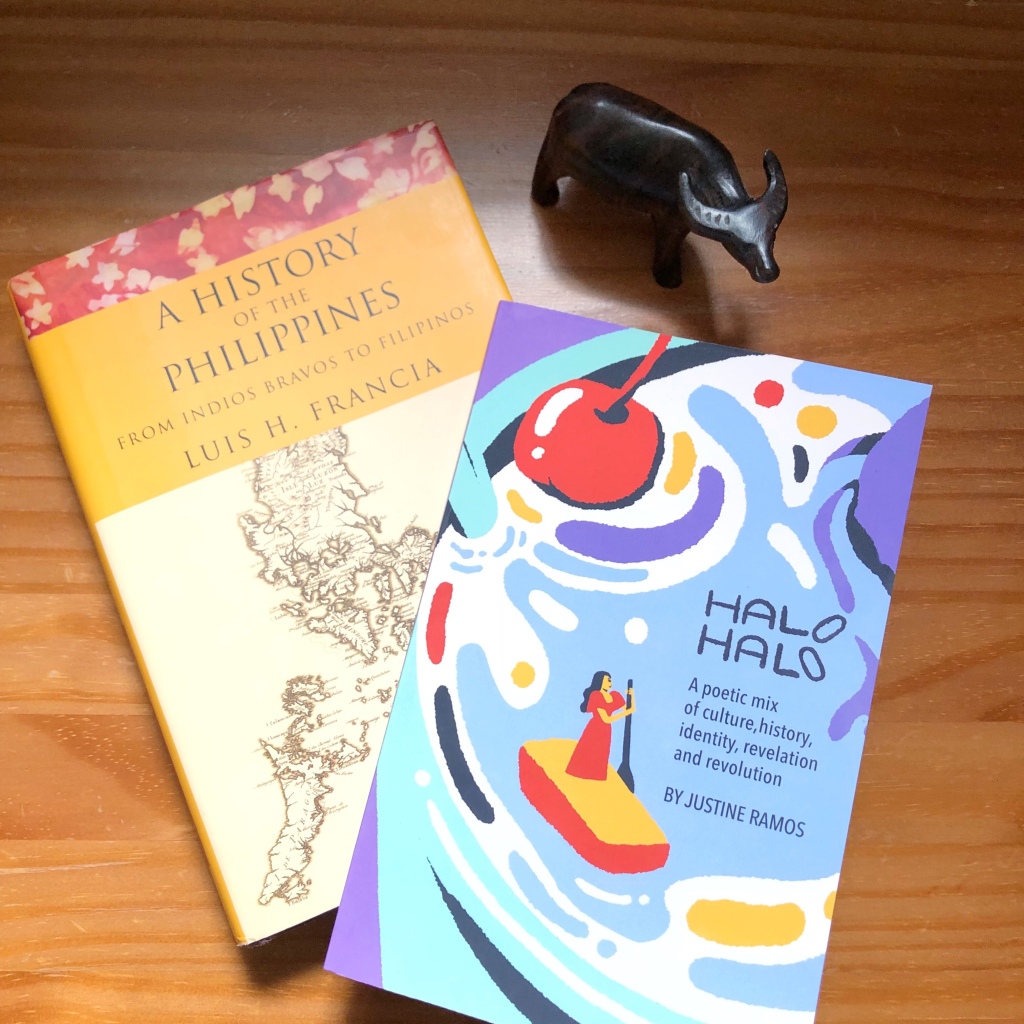
A History of the Philippines: From Indio Bravos to Filipinos, by Luis H. Francia
This book dives into the history of the Philippines from pre-colonial days to the present. Though this is an amazing resource for a Filipinx wanting to learn about their ethnic heritage, this is a book for everyone. By including perspectives and parts of stories that were left out of our history textbooks in the US, it challenges the way we view European and American history and adds insight to discussions about racism, colonialism, militarism, and even missiology.
Halo-Halo: A poetic mix of culture, history, identity, revelation, and revolution, by Justine Ramos
This is the book I mentioned earlier with the poem called, “Ferdinand Magellan.” In a podcast, I heard Ramos talk about how publishers told her that her themes were for “too specific of an audience” and that she should try to write for a wider, more general audience. I’m so glad she didn’t diminish the power of her words by diluting her creativity! This book is a work of art. Through her slam-style poetry, Ramos gives insight into the experiences and psyche of the Filipinx diaspora. At times, her words feel like lament. Other times, like revolutionary anthems. This book was like a healing balm to my soul.
In the Author’s Note, she wrote:
“My poetry is dedicated to all the textbooks that left my country and culture out of the narrative. My poetry is devoted to anyone who has ever uttered “Hirap Buhay ‘Merica” [“Life’s Hard in America] under their breath…As you turn the page, you’ll read snippets of frustrations and reflections. You’ll read flashes of my childhood, a peek into the crevices of my heart and memory. You’ll hear outrage, hope, and a desperate call for advocacy and awareness. These pages contain the tears of those who have lost a sense of themselves, those who have let the world define who they are, and the strength of those who, like me, are on the journey of finding themselves again.”
WHAT ABOUT YOU?
Are you on a journey of reclaiming your identity? What are you doing to reclaim the pieces of your story and culture you have lost, forgotten, or never had? I’d love to hear from you! (You can share in the comments.)
“We must always take sides. Neutrality helps the oppressor, never the victim. Silence encourages the tormenter, never the tormented. The opposite of love is not hate, it’s indifference.”
~Elie Wiesel, Holocaust survivor and winner of the Nobel Peace Prize in 1986
As a woman of color navigating all the ways this past year has brought my racial pain and trauma to the surface, there are words I need to hear from the people in my life:
“I see you.”
“I’m here for you.”
“I’ve got your back.”
For those of you who are leaders, I need to hear the same from the leadership of the organizations and institutions I’m part of:
“We see you.”
“We’re here for you.”
“We’ve got your back.”
Why is this so important? Because, as Elie Wiesel states, “Silence encourages the tormenter, never the tormented.” For me personally, when the people in my life or the organizations I’m part of offer silence in response to racial pain, what I hear is NOT compassion or empathy. What I hear is:
They do not see me.
They are not here for me.
They do not have my back.
My journal is a place where I feel freedom to express all the things I’m too timid or scared to say out loud. Over the past year, I’ve written in my journal, “I wish they would try. But in order to try, they’d first have to care. And I don’t know anymore if I believe they care.”
So if you care, please don’t believe the lie that silence is the best option. At the least, it can be hurtful (or even feel like betrayal) to those who are hurting. At most, it can embolden those who have deep racism in their hearts and desire to harm racial minorities. Say something!
I know that some of you are reading this and thinking, “I’ve wanted to say something to my friends (or the people I lead) who’ve been hurting during this season, but I haven’t been able to find the words.” I get that. It can be scary to want to say something but to also be afraid of saying the wrong thing. If coming up with the “right” words has felt like an overwhelming and impossible task for you, or if you read the three sentences I shared earlier and thought, “That’s what I’ve been trying to say but I didn’t know how!”—you’re welcome to use them! It doesn’t have to be word-for-word exactly what I wrote. There are so many ways you can express these messages! The important thing is to express them and mean them!
Let’s take a closer look at these three sentences:
“I see you.”
This is the bare minimum. This shouldn’t be controversial. Yet, unfortunately, I know that for some, it is. If you love someone, these words should be easy. The other two sentences are dependent on this one. “I see you” can sound like:
“I’m listening.”
“I see your pain. I’m so sorry you’re going through this.”
“I see the image of God in you.”
“I see your uniqueness. I see your beautiful personality, your giftings, what you bring into a room, the ways you make me better.”
Note: In addition to silence, there are many ways to convey, “I don’t see you.” Some of those ways include arguing instead of listening, gaslighting, defensiveness or making it about yourself when people are sharing their stories of pain with you.
“I’m here for you.”
This one takes a little bit of time, effort, and compassion. This looks like sitting with someone’s pain—even if it’s uncomfortable. “I’m here for you” can sound like:
“If you need to cry or vent, I’m here.“
“Can I give you a hug?”…when it’s safe to do so.
“Can I bring you coffee or a meal?”
“I’ve got your back.”
This one takes some courage. You might get some pushback from those who haven’t taken the time to examine their negative racial biases. But know this: The dignity and worth of BIPOC are worth it! In addition to using your voice to speak up, “I’ve got your back” can sound like:
“I want to be your ally.”
“I want to grow in this area so I can do better.”
“I want to protect you. I will come to your defense if someone tries to harm you.” (These words need to be backed up by action if the opportunity arises!)
“Can I sit with you at church?” Or, “Can I come with you when you go to [insert place where they may need an ally to help them feel safe]?”
“I want to give action to my words. I don’t just want to say things need to be better; I want to do concrete things to help bring change.”
“We need your voice! I’m going to amplify your voice any way I can!”
If you’re in a position of leadership: “How can we do better?” and “How can we come alongside you?”
One more thing: If you can’t mean these words, please don’t say them. I don’t mean that as a slam. It takes repentance and work over time to be able to say each of these things. It’s also a progression: You can’t have someone’s back when you’ve never been (or aren’t at least willing to be) there for them. And you can’t be there for them if you don’t see them (which includes seeing their pain). So if these are words you’ve never said to someone experiencing racial pain or trauma, start by prayerfully examining yourself and asking God, “Since words are the overflow of the heart, what in my heart (and mind) needs to change so I can say these words?” If you can say, “I see you,” but you don’t think you can honestly say, “I’m here for you,” or “I’ve got your back,” bring that to God and be honest about why you feel that way. And then let God shine a light on everything in your heart that wants to hide. Will it be easy? No. But will it be worth it? Yes!
I wrote these words and shared many of them on social media before the Atlanta massacre on March 16, 2021. I considered waiting until a later time to share them on my blog. But one thing the recent tragedy has brought to light is how the limited representation of Asian Americans combined with the weaponizing of terms such as “Kung Flu” and the fetishizing of Asian women has done tremendous harm and has even put lives in danger. I hope that by sharing stories like these, maybe we can start to cultivate change.
Story No. 1:
I went to an art supplies store to look for a certain set of markers that included nine skin tone colors. No luck. The closest thing I found was a six-piece set of skin tone colors—the darkest color a medium brown and none of them were even close to matching mine. I gave up and left the store with a single, green marker for coloring pictures of leaves.
When I got home, I did a search on the internet and found Crayola’s Colors of the World collection—24 beautiful shades ranging from porcelain to deep browns. As I added the marker and colored pencil sets to my Amazon cart, I found myself getting emotional. Memories of drawing self portraits in art class and awkwardly staring at the peach and brown crayons, decades of trying to lighten my skin and avoiding letting my skin tan, years of feeling ugly because “beautiful” photos didn’t include women who had any features that looked like mine. I confronted it all with my Amazon cart. (“Medium deep golden” is the color of me!)
Story No. 2:
When I heard about Raya and the Last Dragon for the first time—the movie with the first Southeast Asian Disney princess—I cried. Full-on, intense, happy tears. I turn 40 this year and I’ve waited my entire life for this! I wish I could tell little, seven-year-old me (or even 25-year old me) that one day my dream would come true. A strong Disney princess who has brown skin and a nose like mine, eats congee, and even has some Filipino martial arts moves—what a time to be alive!
I’m the daughter of Filipino immigrants and most of my closest friends growing up were also the children of Filipino immigrants. They were like cousins and their parents became surrogate titos and titas. I grew up feeling very connected to my Filipino heritage. Now I live hundreds of miles from home in one of the whitest cities in America where I have one Filipina friend. We got to watch Raya together while eating halo-halo.
Bonus: I think getting to watch her four-year-old daughter get into the movie moved me as much as the movie did! Watching this little girl gaze at Raya gave me hope. She’s growing up in a very different world than the one I grew up in, a world where “beautiful” includes her and she’s empowered to be strong.
(And in case you’re wondering, Raya and the Last Dragon was wonderful and lived up to the hype!)
I’ll leave you with a couple thoughts to consider:
Representation matters because people matter. Every single person is created in the image of God. Our ethnicities are a part of the way we reflect the Imago Dei. To diminish anyone’s ethnicity is to diminish the Imago Dei in them.
Representation for people of color doesn’t mean removing representation of White people. There is space for all of us! The attitude that White people lose if people of color get a seat/voice is scarcity mentality and is antithetical to the Gospel and the Kingdom.
What follows is something I wrote months ago when America was reeling and grappling with questions about race. I’ve been unsure of whether or not I wanted to share these words. They’re not exactly “on brand” for my blog. And as time continued to pass, I thought maybe these words would feel like I was trying to talk about something people have moved on from. But then a friend experienced something. Something I’ve experienced and wrote about in these paragraphs.
I’m done hiding.
During this season, I’ve been taking a hard look at ways I’ve chosen to “assimilate” into white culture (or rather, hide my Filipino-ness).
Being a woman of color in predominantly white spaces is tricky. I rarely experience explicit hatred—that doesn’t mean it has never happened—but there are things that lie under the surface. The often asked “Where are you really from?” and “Did your husband meet you on the mission field?” remind me that for many, I’m forever a foreigner. I was born here. This is my home, but I don’t really belong.
And then there’s the issue of what’s safe for me to talk about. I learned early that to talk about my heritage is taboo. Friends could talk freely about the culture of whatever European country their ancestors hailed from, but conversations about my Filipino heritage were unwelcome. This unwelcoming would manifest in a few ways: being made fun of, being told to “go back to my country,” or someone quickly changing the topic. (Note: As for someone quickly changing the topic, this was never something someone would do only once. They never allowed me to speak openly about my heritage even when they spoke openly of theirs).
And then there’s the perceived language barrier. The key word: “perceived.” I speak fluent English with good grammar and a Midwest accent. Yet people still ask me, “Do you understand English?” It’s difficult to prove my intellect to someone who struggles to believe I understand the language I’m speaking fluently. In a similar way, there’s also an assumption that I’m ignorant of American history and culture. As for culture, I get that things were different in my house as both my parents are immigrants. But outside of my house, everything in my life was as “American” as my white counterparts. In fact, because I had to go back and forth between the Filipino culture inside my home and the American culture outside my home, I grew up with a greater awareness of cultural elements many people take for granted and don’t notice.
I was talking about this to a friend recently. She’s Chinese—born and raised in China—and moved to the US as a grad student. When she heard my experiences, she said, “I’m glad I’m not an Asian American! That sounds really hard!” To have to hide an integral part of who I am…Yes, it’s hard.
Over the years, I’ve been extra careful to not assume someone was treating me a certain way just because of my race. It gets hard when I’m in a store and a worker follows me around. One store clerk yelled at me while I looked at skirts. Or the many times when I’m in a women’s boutique and none of the workers will give me service of any kind unless my white husband says to them, “Can one of you please help my wife?” I try to ignore this stuff, smile, and move on.
I’ve found ways to adapt. I’ve assimilated. Or rather, I’ve hidden my Filipino-ness. I’ve dropped Filipino mannerisms. I eat with my hands far less than I used to. I’ve avoided the sun to ensure my skin stayed as light as possible (and I’ve used papaya soap to try to lighten it even more). I’ve done whatever I could to blend into predominantly white surroundings. And because of this, it has been easy for some people to forget that I’m not white. Someone actually told me, “When I see you, I don’t see an Asian; I just see a white girl.” Don’t get me started on all the ways that statement is so so SO wrong. And that’s the thing: I’m NOT white. I’m 100% Filipino. So if you can’t see my Filipino-ness, you can’t see me. (I’m also 100% American. So if you look at me and only see ways I’m other, you can’t see me either.)
So I’ve made a decision: I’m not hiding anymore. What does that mean? I’m not really sure. I’m just gonna let this journey take me where it will.





 Esther Guy