Our Last Love Letter to the Assemblies of God

The following is a life update. I share it here because I know how painful it is to wrestle with the question, “Should I stay?” And we know there are others who’ve wrestled with this question as well. If this is you, may these words help you find clarity and remind you that you’re not alone.

Posted on January 27, 2020. “These are the faces of two people who just passed their AG ministerial credentials exams!!!”

After much prayer, tears, and conversations with wise counsel, we have made the difficult decision to give up our ministerial credentials with the Assemblies of God.

We will continue to hold credentials through the end of the year. But at the end of this year, we will not renew them.

My family has been part of the AG for generations—going back to my grandmother in the Philippines. Daniel got saved in high school when a friend invited him to an AG church. We have deep roots in the AG. And there are so many people in the AG who have been dear friends; many who feel like family. To make this decision to leave is one that comes with an immense amount of grief.

When people have asked me why I stay—a question we’ve received many times over—I’d tell them the names of people in the AG: pastors and mentors, people we’ve worked alongside, friends we’ve had coffee and meals with, and students we’ve ministered to over the years. I’d say, “I stay because of the people who came before me, those who walk alongside me, and for those who will come after me.”

Over the years, so many people have told us, “Daniel and Esther, if you can stay in the AG, then I can stay, too.” In Bible college, one of our professors repeatedly told us, “Stay in the AG so you can make it better and bring change from the inside.” We’ve carried these words with us for over 23 years. In our 14 years in Springfield, MO, and even in the short time since we left, we’ve repeated them many times over. But over the past several weeks, we’ve no longer been able to say these words in good conscience.  

We’ve done everything within our power to help make the AG better. In addition to faithful service in AG churches and ministries, this includes me writing a letter to the Executive Leadership Team concerning an issue in 2020 and being part of the XA Diversity Task Force our last couple years in Springfield—a way to use my voice and gifts to help bring good change at a national and systemic level. We made the most of every opportunity given to us, and we forged paths in places where there was no path.

We were committed to staying for as long as we felt the call to stay and for as long as we felt able. 

As we were in the midst of discerning whether we should stay or walk away, a mentor told us to consider two things:

1. The mission – Is staying in the AG and carrying the AG name a liability that’s getting in the way of our mission and ability to share the Gospel?

2. Conscience – Do we feel we can no longer stay in good conscience?

Unfortunately, the answer to these two questions is yes. Additionally, though we believe in living a cruciform life—those who know us are aware we have not shied away from suffering—our well-being also matters. Though we can recount countless, beautiful experiences while in the AG, we’ve also experienced and seen things that have been soul-crushing. As we continue to do the work God has called us to do, it’s unsustainable for us to continue to stay in an organization that feels like it’s crushing us. And we believe it’s time for us to prioritize our healing. 

We’re well aware that every church, organization, and denomination has its issues. But there are things in the Assemblies of God that disturb us.

We’re disturbed by:

1. Christian Nationalism and the aligning with Trump and right wing politics, to the point of ignoring and disregarding Scripture when it doesn’t fit with partisan talking points. I lamented to a mentor, “Increasingly, it feels like it’s more important to the AG that we preach about the rapture than to care for the poor and the immigrant.” The AG is really loud about things that the Bible is quiet or unclear about, but really quiet (often silent) about things the Bible is really loud about.

2. Racism – There are many instances in which “they didn’t intend” anything hurtful. But I’m fully aware that these same people also didn’t intentionally take the time to learn and listen to different perspectives within our movement so they could be aware of the ways they may be causing harm or denigrating people they claim to care for. And there are way too many instances of blatant, explicit racism by AG credential holders that are never addressed despite the AG’s statement in 2020 that we would “oppose racism in all its forms.” This isn’t just an issue I’m passionate about; it’s something that impacts me on a personal level. As a Filipino-American who works in a ministry where the majority of our students are either immigrants, children of immigrants, or international students, I don’t have the option to not care about this. And the AG’s failure in this area has been a source of repeated heartbreak and pain.

3. Missteps in handling various kinds of abuse, ranging from national scandals to the ways abusive practices are allowed to flourish in local contexts. We minister at Princeton University. These students ask a lot of questions, probing and scrutinizing over every detail. And they Google. If they Google the AG, we know what they will find. We also know what they will not find. How beautiful and compelling if, along with the messiness, they also saw a movement that overwhelmingly chose humility and repentance. But Daniel and I, with all our love and hope for the AG, haven’t seen that, so there’s no way we could expect a student who’s skeptical of Christianity or who has been hurt by the Church to see it either. But even without scandals in the headlines, we’ve had too many friends who’ve been victims of abuse within the AG, and we’ve been heartbroken to see the ways they’ve suffered while their abusers have faced no consequences.

We know so many within the movement for whom the concerns above do not apply in any way. But we also know the AG can be better. We firmly believe it, and we wouldn’t have stayed for as long as we have if we didn’t. While we believe we were in the AG “for such a time as this,” that time is coming to a close for us. It is now time for us to heal, focus on the people in the place where our feet are, and make room for other Esthers and Daniels—Old Testament references intended—to rise up within this movement. We wish the best for the future of the Assemblies of God and will continue to pray for her. 

Thank you, Assemblies of God, for instilling in us a deep love for God, Scripture, and the Church. Thank you for praying and crying with us in difficult seasons, for celebrating with us in major moments of our lives, and for giving us beautiful friendships we will carry with us for the rest of our lives. ❤️

I’d like to address some questions you may have:

Are you cutting all ties to the Assemblies of God?

Absolutely not!. Though we will no longer carry ministerial credentials with the AG, we’ll continue to consider the AG family and to pray for the AG. We fully intend to keep the relationships we’ve made! At the same time, we understand our leaving will be reason for some to cut ties with us, but we will not be the ones cutting those ties. Additionally, we will continue our financial support for AG missionaries. To those who feel called to stay, we still believe in the work you do and we are proud to partner with you in that work.

Is anything changing in your work?

Nope! We’ll still be on staff at Manna Christian Fellowship. Because Manna is inter-denominational, our leaving the AG will not negatively impact our work.

Did moving to Princeton cause you to change in your beliefs? 

No. Our hearts and minds are still very AG. 

Are you going to get credentialed with another denomination?

We’re praying and discerning about our next steps. We’re not going to rush into anything so we can give ourselves some time to grieve and heal. But we do have a sense of where we will go. We appreciate your prayers as we navigate this complex transition.

What do I do if I’m struggling to stay?

1. Make sure you have community where you find solidarity and safety to lament, be angry, and struggle. And make sure some of those people can give you hope and encouragement when you need it without spiritual bypassing.

2. Have a list of reasons you stay. My list was names of people. I stayed for so long because of the people on that list who came before me, the ones who’ve walked beside me, and the ones who would be coming up behind me.

3. Keep close to the Lord and don’t lose your uniqueness, particularly your insight that sets you apart. The AG may try to hammer that off of you, but stay in the counsel of God and be your full self that He created you to be.

4. Get a therapist or counselor if you don’t already have one.

5. Stay as long as you feel you can, and allow yourself to feel the grace of God’s release when you can’t anymore. 
Live Out of Love

At the start of every school year, Manna Christian Fellowship at Princeton University does a special Old Timers Large Group for sophomores, juniors, and seniors. What follows is the message I shared at this year’s Old Timers on September 3, 2025.

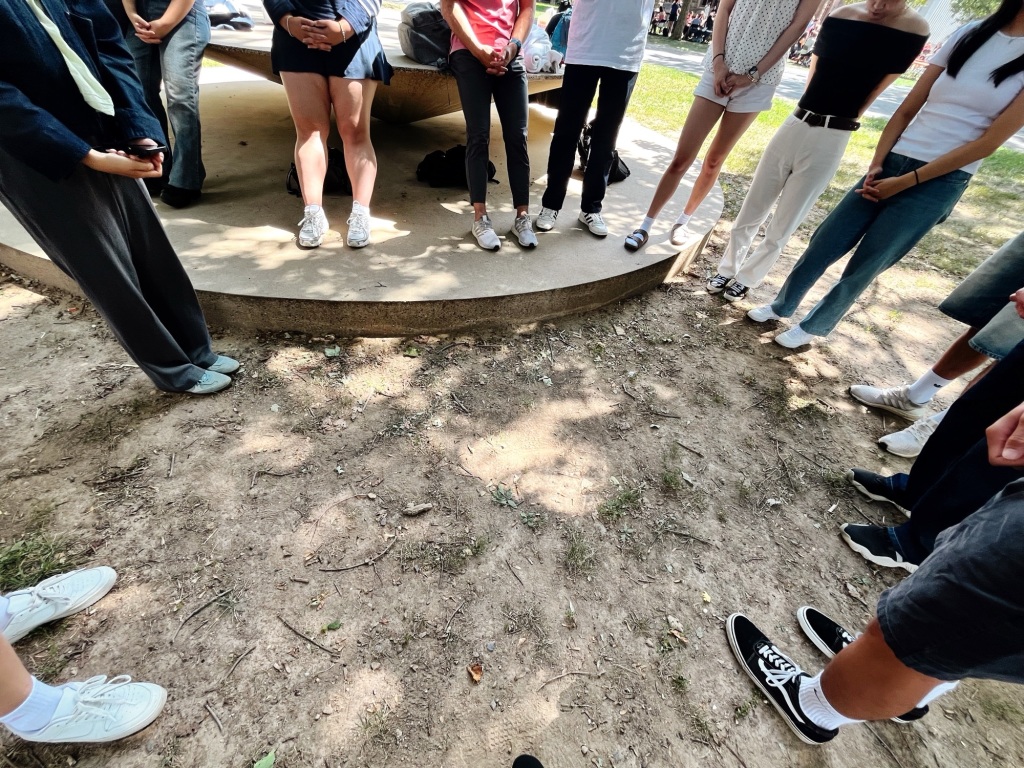
Prayer at “The Cone” sculpture before Manna’s first event of the school year, an ice cream social to welcome freshmen.

As we begin a new school year, here’s what I want you to get:

You are deeply loved by God.

And because you are deeply loved by God, 

love God with your whole being, and love people without exception.

There’s a term in theology and Biblical studies: “synoptic Gospels.” In Manna, we talk a lot about the Gospel, the good news of the Kingdom of God. That word, gospel, also refers to the first four books in the New Testament: Matthew, Mark, Luke, and John. All four of them give an account of the life and teachings of Jesus. And the Synoptic Gospels refers to three of those books: Matthew, Mark, and Luke. The reason they’re called the synoptic Gospels is because they’re quite similar and have a lot of overlap. And John, though he talks about the same Jesus and there’s some overlap as well, his book is very different from the other three. Why are there differences in the accounts of the life of Jesus? If you had four different people telling you about the life of [pick random student], you’d hear four different accounts, different details and emphases, different ways of describing the same person. All true, but just from different perspectives. For example, Daniel and I get asked so many times how he proposed. I tell that story very differently from the way Daniel tells it. Which telling is right or more true? They’re both right, and they’re both true. And hearing it from both our perspectives gives you a fuller picture.

So here’s what we’re going to do. We’re going to explore a story that’s found in all three of the Synoptic Gospels. And then, we’ll see what John, the author of the last Gospel, has to say about the matter. And as we explore, I want you to consider two questions:

  1. Do I live like love is as important as Jesus said it was? 
  2. What gets in my way of loving God and loving people?

The Perspective of Matthew

If you have your Bible, open up to Matthew 22. While you do that, let me give you some context. In the preceding chapter, chapter 21, Jesus rode into Jerusalem on a donkey, and there were palm branches, and people were shouting, “Hosanna to the Son of David!” It was basically a royal procession. And after that, Jesus went into the temple, and He started flipping over the tables of the money changers and those selling doves. This was happening in the Court of the Gentiles, the place that was supposed to be where those from every nation could come and worship God, but that place was being overrun by people who were distorting sacrifice and worship into a commercial endeavor, thereby excluding the nations to whom God had called His people to be a blessing. Jesus flipped the tables of injustice, and the religious leaders got mad and began to search for a way to do away with Him. So in chapter 22, we see various groups approaching Jesus, trying to trap Him with different theological tests/questions. In Matthew 22:34, we come to their last test to Jesus.

Matthew 22:34-40 (CSB)

When the Pharisees heard that he had silenced the Sadducees, they came together.  And one of them, an expert in the law, asked a question to test him: “Teacher, which command in the law is the greatest?”

He said to him, “Love the Lord your God with all your heart, with all your soul, and with all your mind. This is the greatest and most important command. The second is like it: Love your neighbor as yourself.  40 All the Law and the Prophets depend on these two commands.”

After this, Jesus turned around and presented them with a question and they weren’t able to answer Him. Then in Matthew 23:1-4, the story continues. 

Matthew 23:1-4 (CSB)

Then Jesus spoke to the crowds and to his disciples: “The scribes and the Pharisees are seated in the chair of Moses. Therefore do whatever they tell you, and observe it. But don’t do what they do, because they don’t practice what they teach. They tie up heavy loads that are hard to carry and put them on people’s shoulders, but they themselves aren’t willing to lift a finger to move them.

Jesus calls us to a love that is embodied and seen through action rather than being enslaved to legalism, perfectionism, purity tests, and the appearance of piety. 

The Perspective of Mark

Let’s look at Mark 12. The context here is the same as the book of Matthew: Jesus flipping over tables of injustice, the religious leaders trying to trap Him. But when we get to Mark 12:28, the tone shifts. 

Mark 12:28-34 (CSB)

One of the scribes approached. When he heard them debating and saw that Jesus answered them well, he asked him, “Which command is the most important of all?”

Jesus answered, “The most important is Listen, Israel! The Lord our God, the Lord is one. Love the Lord your God with all your heart, with all your soul, with all your mind, and with all your strength. The second is, Love your neighbor as yourself. There is no other command greater than these.”

Then the scribe said to him, “You are right, teacher. You have correctly said that he is one, and there is no one else except him. And to love him with all your heart, with all your understanding, and with all your strength, and to love your neighbor as yourself, is far more important than all the burnt offerings and sacrifices.”

When Jesus saw that he answered wisely, he said to him, “You are not far from the kingdom of God.” And no one dared to question him any longer.

What strikes me about Mark’s telling is that the scribe seemed genuinely interested. And Jesus’ positive response to him makes me wonder what happened to this scribe. Did he ever become a follower of Jesus? We don’t know. All we know is that in this moment, as he demonstrated an understanding of the supremacy of love, Jesus said he was “not far from the kingdom of God.” 

As we keep reading a few verses later, starting in verse 38,

Mark 12:38-44 (CSB)

He also said in his teaching, “Beware of the scribes, who want to go around in long robes and who want greetings in the marketplaces, the best seats in the synagogues, and the places of honor at banquets. They devour widows’ houses and say long prayers just for show. These will receive harsher judgment.”

Sitting across from the temple treasury, he watched how the crowd dropped money into the treasury. Many rich people were putting in large sums. Then a poor widow [Remember that Jesus just talked about scribes devouring widows’ houses.] came and dropped in two tiny coins worth very little. Summoning his disciples, he said to them, “Truly I tell you, this poor widow has put more into the treasury than all the others. For they all gave out of their surplus, but she out of her poverty has put in everything she had — all she had to live on.”

So many people preach this passage to say, you need to be like the poor widow and sacrifice everything you have for God. But read in context, this is not that. Nowhere does Jesus say that what this widow was doing was a good thing. He wasn’t criticizing her, but His words weren’t exactly praise either. It was more like lament. He was saying, “Here is a living example of the way scribes and religious leaders are devouring widow’s houses and causing them to be destitute. Look at the inequity of someone who has very little giving everything, while people who have everything give comparatively very little.” This year, our theme in large group is going to be “Jubilee.” You can read about the idea of Jubilee in Leviticus 25 and Luke 4:16-21. But for now what I want you to know is what was happening in this passage, what the religious leaders and rich people were doing and allowing to happen to widows was not jubilee and was antithetical to the Gospel. 

The scribe understood and could wax eloquently about the command to love God and love people, but there was a disconnect between the knowledge the scribes had and how they lived their lives. The scribes were pious and they prayed long prayers, but they were also greedy and unjust. Love does not tolerate injustice. 

The Perspective of Luke

Luke puts this story earlier in the narrative and in Jesus’ ministry. Jesus wouldn’t flip the tables of injustice until chapter 19. If you glance at the subject titles leading up to this point, you’ll see things related to Jesus’ identity and His mission, as well as His invitation to His followers to be like Him and participate in that mission (“Peter’s Confession of the Messiah,” “His Death and Resurrection Predicted,” “Take Up Your Cross,” “The Power of Jesus over a Demon,” “Sending Out the Seventy-Two…”). With that setup in mind, let’s read Luke 10:25-37.

Luke 10:25-37 (CSB)

Then an expert in the law stood up to test him, saying, “Teacher, what must I do to inherit eternal life?” 

“What is written in the law?” he asked him. “How do you read it?”

He answered, “Love the Lord your God with all your heart, with all your soul, with all your strength, and with all your mind,” and “your neighbor as yourself.”

“You’ve answered correctly,” he told him. “Do this and you will live.”

But wanting to justify himself, he asked Jesus, “And who is my neighbor?” 

This expert in the law was basically asking Jesus, “Who do I have to include and who am I allowed to exclude?” And Jesus’ response was scandalous. “You think you’re an expert in the law? Let me tell you a parable about how the kind of people that you look down on understand the law better than you.”

Jesus took up the question and said, “A man was going down from Jerusalem to Jericho and fell into the hands of robbers. They stripped him, beat him up, and fled, leaving him half dead. A priest happened to be going down that road. When he saw him, he passed by on the other side. In the same way, a Levite [another religious leader], when he arrived at the place and saw him, passed by on the other side. But a Samaritan on his journey came up to him, and when he saw the man, he had compassion. He went over to him and bandaged his wounds, pouring on olive oil and wine. Then he put him on his own animal, brought him to an inn, and took care of him. The next day he took out two denarii, gave them to the innkeeper, and said, ‘Take care of him. When I come back I’ll reimburse you for whatever extra you spend.’

Through the story of the Good Samaritan, we see a love that’s not abstract, but concrete:

What does concrete love look like? Three phrases:

  1. I see you.
  2. I’m here for you.
  3. I’ve got your back. 
  • The Samaritan didn’t just see that the man was there. The religious leaders saw him, too. But they didn’t see him in his full humanity, as someone created in the image of God and loved by God, who was suffering and in need of care. But the Samaritan truly saw him and was compassionate enough to stop.
  • He bandaged his wounds (which means he was willing to look at some ugliness)
  • He gave his resources: oil, wine, money. And where did he get bandages? Did he rip up his own clothes or another one of his valuables to make bandages for this stranger?
  • He gave his time, not just in that moment, but in the days to come.
  • And the Samaritan made sure the man was safe and out of harm’s way.

“Which of these three do you think proved to be a neighbor to the man who fell into the hands of the robbers?”

“The one who showed mercy to him,” he said.

Then Jesus told him, “Go and do the same.”

Here’s the beautiful thing: Jesus wasn’t like the religious leaders who didn’t practice what they taught. In Jesus’ life—His incarnation, crucifixion, resurrection, through His teachings, and presence, and miracles, and in the ways that He advocated for the marginalized and cared for the broken—He communicated over and over again: “I see you, I’m here for you, and I’ve got your back.” And He is still speaking and living those words for us today. That is love.

The Perspective of John

Throughout the Gospel of John, there’s so much talk of love. John 3:16—“For God so loved the world…”.John 15—”Remain in my love…” Rather than going to the Gospel of John, I’m going to have us go to one of his letters at the end of the Bible. 

1 John 4:7-11, 18-21 (CSB) 

Dear friends, let us love one another, because love is from God, and everyone who loves has been born of God and knows God. The one who does not love does not know God, because God is love. God’s love was revealed among us in this way: God sent his one and only Son into the world so that we might live through him. Love consists in this: not that we loved God, but that he loved us and sent his Son to be the atoning sacrifice for our sins. Dear friends, if God loved us in this way, we also must love one another.  

There is no fear in love; instead, perfect love drives out fear, because fear involves punishment. So the one who fears is not complete in love. We love because he first loved us. If anyone says, “I love God,” and yet hates his brother or sister, he is a liar. For the person who does not love his brother or sister whom he has seen cannot love God whom he has not seen. And we have this command from him: The one who loves God must also love his brother and sister.

You are deeply loved by God. And because you are deeply loved by God, love God with your whole being, and love people without exception.

Now here’s the thing: Love is not some fluffy, light, easy thing. Love is messy. It takes work, laying down our pride, sacrifice, and vulnerability. Love is brave. And Jesus didn’t just tell us to love our friends and the people in our community. He also told us to love our enemies. And He told a story about how the people we look down on or despise may be the ones who need to teach us how to love.

Love is hard. And we mess up. We fail to love God. And we fail to love people well. So what do we do? 

Let’s look at one more passage written by John, except this time in the wonderfully weird book of Revelation. Revelation 2:1-5. This book is a series of visions that John had. And in this passage, he’s told to write letters to various churches. 

Revelation 2:1-5 (CSB)

“Write to the angel of the church in Ephesus: Thus says the one who holds the seven stars in his right hand and who walks among the seven golden lampstands: I know your works, your labor, and your endurance, and that you cannot tolerate evil people. You have tested those who call themselves apostles and are not, and you have found them to be liars. I know that you have persevered and endured hardships for the sake of my name, and you have not grown weary. But I have this against you: You have abandoned the love you had at first.  

In the IVP Bible Background Commentary, Dr Craig Keener wrote, “Sound doctrine and perseverance are inadequate without love.” 

So back to the question: What do we do? What do we do when we’re not loving God or living out of that love?

John goes on:

Revelation 2:5 (CSB)

Remember then how far you have fallen; repent, and do the works you did at first. 

Jesus doesn’t say, “The moment you fail to love well, that’s it. I’m done with you.” No. He says, to repent (to turn back to Him), and to do the works you did at first (to be with Him, not just to ask Him for things, but to be with Him), and keep coming back to Him and to His love. Now just to be clear: in saying “do the works you did at first,” this does not mean you need to do works to earn God’s love. You cannot earn God’s love; God loves you. Period. So why talk about doing works? Because it takes work to cultivate our love for God and for others. And, like we saw in the Gospels, love is not some abstraction. It is concrete, made visible through action. So every day, keep returning to Jesus and keep doing the things that cultivate your love for Him and others

So here’s what I want you to carry with you as you start this new school year and for the rest of your life:

You are deeply loved by God. And because you are deeply loved by God, love God with your whole being, and love people without exception.

Let everything you do and everything you strive to be flow out of that love.

My Name Is Esther: A Love Letter and Lament

A childhood photo of Nanay Ching, my grandmother.

My name is Esther. I was named after a White, American, Assemblies of God missionary. She was the pastor’s wife at the church in the Philippines where both my parents were saved and got married. My father grew up in this church. His mother, Nanay Ching, was one of the founding members when this church was planted in the 1950s by an American missionary. Nanay Ching became the church’s head treasurer. She was a pillar of the church, a prayer warrior, called a mother by all who knew her.

When I was a little girl, I have a memory of both Nanay Ching and the Esther for whom I was named visiting my family in Chicago. Standing outside my church after the Sunday service, these two mighty women of God held hands and my grandmother said to me, “This is my best friend.”

I’m as AG as one could get: I went to kids camp where I was filled with the Holy Spirit with the physical evidence of speaking in tongues. I went to youth camp where I experienced the call of God to be a preacher of the Gospel. I did Teen Bible Quiz, memorizing the book of John, yet scoring badly in meets. I won Fine Arts twice. I graduated from Central Bible College with a degree in Preaching and Evangelism. Because music is one of my favorite languages with which to declare the mysteries of the Gospel, I got a master’s degree in piano performance. And though the many hours of practicing was brutal on my hands that were already showing signs of lupus before I knew I had lupus, I still played on the worship team at my AG church on Sundays and Wednesdays. Whether I found myself in a church or college campus, I’ve been obedient to God’s call on my life. Today, I’m on staff at a campus ministry at Princeton University. All because of an Assemblies of God missionary who started a church in Manila, Philippines and the Assemblies of God missionaries who continued that work.

Somewhere in the midst of my life story, my husband and I ended up moving to the Philippines to join the pastoral staff at that church. One day one of the pastors I shared an office with was rummaging through one of the closets and shouted, “Oh, Pastora Esther! Look! It’s your video!” A VHS tape my dad made with a compilation of my performances and preaching, sent to my grandmother, made its way into the hands of the pastors of that church.

That church is no longer an Assemblies of God church. The story, which happened decades before my time there, is tragic and sad. I don’t know all of the details, and the details I do know are murky. But I do know that when we would visit my grandmother on our days off, she would say, “You’re Assemblies of God?”

“Yes, Nanay Ching. We’re Assemblies of God.”

And she’d lower her head and close her eyes as she’d say, “The Assemblies of God tried to steal from us.”

I do believe a lot of good changes have been made at an institutional level to not repeat some of the sins of our fellowship’s past. But there’s still something sinister lurking in the shadows, silently seeping into the handiwork of good intentions mixed with unexamined colonialism and paternalism.

I experienced it as a youth when a friend and I were invited to perform at a district council. My pastor introduced our families to some ministers and said, “Our church has a lot of ethnicities.” That statement filled me with pride, but I remember feeling uncomfortable as they gawked at us like we were oddities. And I guess, in light of what the people in the rest of the room looked like, we were.

I experienced it in Bible college when a number of my peers told me I needed to learn how to act more White.

I experienced it when my home church did a missions trip to the Philippines, a trip that would be especially meaningful to the Filipino-Americans going on that trip. Before that trip, the missionary visited our church to do a training for us. After the training, all of us (including the missionary) were invited to a party at someone’s house. My Filipino-American friends and our immigrant parents were horrified as the missionary participated in the karaoke, singing with a mocking, over-the-top, Filipino accent.

I experienced it when a missionary in residence at my Bible college said in front of the class, “This is how all Eastern people think. Right, Esther?” And then when he tried to explain to me how I think when I was stunned to silence.

Missionaries have been the most likely to doubt I’m fully proficient and fluent in English and to assume my husband met me when he was “ministering to me” in the Philippines. They struggle to believe my husband and I went to Bible college together (in America!) and graduated with the same degree.

I wish I could believe all ministers and missionaries always know what the people they minister to need most and what communicates dignity to them. I know many for whom this description is accurate, wonderful mentors and close friends for whom I’d take a bullet because they’ve loved me so well and I love them so. There’s one youth pastor—a lead pastor now—I feel especially indebted to. He took time to teach me homiletics (the art of preaching) when I was fifteen. He mentored me and took risks in giving me responsibilities. He helped carry my burdens and taught me by example what it means to love and pastor. And he pushed me to dig deeper and think more critically about Scripture. I honestly don’t think I’d be where I am today without his deep impact on my life decades ago.

I’ve seen the goodness that can be. But I’ve been cut and bruised by too many ministers and missionaries to give blind trust to all. I have caution. And when people show me who they are, I believe them.

I know a mighty woman of God who is brilliant, talented, and blind. Her name is Sarah Sykes Weingrtner. She wrote to me, “Still waiting and praying for the day they see us as full ministry partners rather than people who need to be reached.”

We don’t just want to be welcomed into spaces and to not be demeaned. That is too low a bar. We want more:

We want to be included in “us,” and not relegated to “them.”

We want to be counted as peers, not projects.

We want to be seen, to have seats at tables of decision, for our voices to be heard, and for our wisdom to be valued and heeded.

My dear Assemblies of God family, I’ve seen glimpses of what we could be, but we are not there yet. Maybe one day. With repentant humility and the transformative power of the Holy Spirit, let us work to make it so.

“Let us not get tired of doing good, for we will read at the proper time if we don’t give up. Therefore, as we have opportunity, let us work for the good of all, especially for those who belong to the household of faith.” ~Galatians 6:9-10 (CSB)

The Ministry of Care for All People

The following is a message I shared on November 17, 2023 at a multicultural worship service at Evangel University that was put on by Jubilee (a multicultural worship team) and E-Unite (an organization that focuses on Kingdom diversity).

“In those days, as the disciples were increasing in number, there arose a complaint by the Hellenistic Jews against the Hebraic Jews that their widows were being overlooked in the daily distribution. The Twelve summoned the whole company of the disciples and said, “It would not be right for us to give up preaching the word of God to wait on tables. Brothers and sisters, select from among you seven men of good reputation, full of the Spirit and wisdom, whom we can appoint to this duty. But we will devote ourselves to prayer and to the ministry of the word.” This proposal pleased the whole company. So they chose Stephen, a man full of faith and the Holy Spirit, and Philip, [and a whole bunch of other people with Greek sounding names I can’t pronounce]. They had them stand before the apostles, who prayed and laid their hands on them. So the word of God spread, the disciples in Jerusalem increased greatly in number…” (Acts 6:1-7)

One day my husband, Daniel, and I wanted to eat at a certain restaurant. And as we got close, we had a hard time finding parking, so Daniel dropped me off so I could put our name in while he found a parking spot. I walked in and went to where the hostess area was. When I got there, the hostess was greeting another party and seating them. I saw her see me; she knew I was there. And I thought, I’m just going to wait here for a minute; she’ll be back.” Many minutes passed. No hostess. I stepped into the dining room so that maybe one of the waitresses would see me. I saw waitresses see me and quickly avert their eyes. None of them acknowledged my existence. (If you’re wondering: I was the only non-white person in the room.)

I went back to the hostess area and kept waiting. Eventually Daniel showed up and he was surprised that I was still waiting for someone—anyone—to help me. We waited a little longer, then finally, the hostess showed up. She smiled, looked straight at Daniel (who arrived after me) and said, “Table for one?” 

“No, table for two.” 

After we were seated, no one came to bring us water or take our order. We sat there long enough for Daniel to say, “If no one comes to our table in the next five minutes, we’re leaving.” Shortly after that, we saw a group enter. The hostess immediately greeted them, seated them at a table, and brought them water. 

So we got up. And on our way out, Daniel said to the host, “We’re leaving. No one’s giving us service. And it feels like you don’t want us here.”

And with a smile on my face—because I inherited the Filipino habit of smiling when I’m upset—I said, “And it feels kinda racist.”

At that point, one of the waitresses who had refused to acknowledge my existence up to that point came out acting very apologetic and said to me, “It wasn’t intentional.”

By that point, my heart was beating so fast I couldn’t form words. But I wish I could’ve had the wit to say, “Yeah, I know it wasn’t intentional. You don’t need to be intentional for your internal biases to slip out. You need to be intentional to make sure that every person who comes into your establishment is given the same level and quality of care.”

“Table for one?”

“It wasn’t intentional.”

Those words have stuck with me. Not because I haven’t forgiven those people. I did. Me and Jesus had a long talk and cry about it; we’re good. But those words stuck because they articulate experiences I’ve had—out and about in Springfield and even in Christian spaces. And they summarize many of the experiences other people have shared with me. Ways we’ve felt invisible or erased. Ways that people have let us down with careless words, actions, or neglect. 

What I want to talk about today is the ministry of care for all people. Everyone needs care. Today, I’m going to talk about care through the lens of Kingdom diversity. I’m also speaking through the lens of a Filipino-American and Asian-American woman because that’s what I am. It would be easy to dismiss my words and say, “Well she’s an Asian woman, so what she’s saying doesn’t apply to me.” But I want to be clear that this message isn’t just about caring for Asians or caring for Black and Brown people. This is for everyone. 

Care is an important theme throughout Scripture. 

In Acts 6, we read an account of a time when the early Church was experiencing growing pains. The Hellenistic Jews were complaining. Why? “Their widows were being overlooked…” I don’t think it’s because of malicious reasons. I think there were other factors at play and it was more like what the waitress said to me: “It wasn’t intentional.” Whatever the reason, this group of people was being overlooked.

And when the Hellenistic Jews saw the lack of care their widows were receiving, they advocated for them. And when their complaint reached the apostles, the apostles chose to not look away. 

The apostles knew their job: They were the first-hand witnesses of Jesus’ life, teachings, and ministry. They couldn’t pass on that role to someone else. In order for the foundation of the Church to be strong, they needed to be devoted to that work. 

But at the same time, they didn’t tell the Hellenistic Jews, “Don’t talk about that stuff. It’s a distraction from the Gospel.” They didn’t bad-mouth the Hellenistic Jews for complaining or try to shut them up. What did they do? The apostles listened and made a pathway for the people who were affected the most to rise up in leadership and deal with the issues. They publicly supported and empowered them and signaled to the Church that these people had the authority to do what they were doing. AND they laid their hands on them and prayed for them.

They made sure the preaching of God’s Word continued. And they made sure everyone was given the care they needed.

And what was the result? “So the word of God spread, the disciples in Jerusalem increased greatly in number…” (Acts 6:7).

I’ve heard people say, “Talking about racism or racial issues is a distraction from the Gospel.” Let’s set the record straight: People NOT being cared for is a distraction from the Gospel. And people not being cared for or not receiving the same level of care as others because of racial or ethnic reasons is a distraction from the Gospel. 

The Gospel is so much more than just getting saved. Yes, salvation is a vital part of it, but it’s also so much more than that! The Gospel is an invitation to be part of the Kingdom of God—not just as a worker, but also to belong in the Church and family of God. This goes beyond welcome. We are to embody the Gospel. And part of embodying the Gospel means both giving and receiving care.

Everyone needs care. We need care when things are going well and when things are not. And when we experience tragedy, trauma, neglect, or anything heavy, our need for care rises.

So what does care look like?

“I see you.”

“I’m here for you.”

“I’ve got your back.”

In seasons that have brought my racial pain and trauma to the surface, those are the words I’ve needed to hear.

I’ve needed to hear the same from the leadership of the organizations and institutions I’m part of:

“We see you.”

“We’re here for you.”

“We’ve got your back.”

And when the people in my life offer silence in response to my pain, what I hear is NOT compassion or empathy. What I hear is:

They do not see me.

They are not here for me.

They do not have my back.

Let’s be people who live the words, “I see you, I’m here for you, and I’ve got your back.”

1. I see you. 

Before we go further, let’s take a moment and talk about “colorblind” language like, “I don’t see color.” 

To start out, a person’s color does NOT determine someone’s worth, competency, or goodness. Do NOT judge anyone based on their ethnicity or color. If seeing color leads you to dehumanize people or treat people badly, ask God to fix the part of your heart that’s struggling to love people the way He does.

So now, if judging people based on color is wrong, does that mean we should be “colorblind”? No.

When someone says to me, “Esther, I love you. I don’t see your color…”

First of all, yes, you do. If you look at me and cannot tell that I’m not White, then let’s go to the doctor and get that looked at because that’s a problem! 😉

Second, when I hear, “I don’t see your color,” that doesn’t make me feel loved. It makes me feel like, “What is so shameful about my color that you don’t want to see it?” Being told “I don’t see your color,” for so many years and taking it in without question caused a lot of damage. It caused me to tear down the imago Dei in me every time I looked in the mirror. Years of whitening products, dropping my middle name because it sounded too “ethnic,” hiding my Filipinoness every way I could. God did not put me in a Filipino family and in a Filipino body for me to look at those things with shame and erase those parts of myself. God sees my color. And it is good. 

Some of you need to hear this today: God sees your color. And it is good.

So why should we see color?

  • Because diversity is beautiful. In the book of Revelation, one of the things that John marveled at is when he saw “a vast multitude from every nation, tribe, people, and language.” (Revelation 7:9)
  • Because when we refuse to see a person’s color, we also miss the gifts and perspectives they can bring to the Church and society that were cultivated by their ethnic or cultural background. (For example, growing up in a Filipino household, food is love and it plays an important part in how I relate to other people. So when we see scenes in Scripture where people are eating together, I notice things that others miss and I can help people have a more robust theology.)
  • And because we live in a fallen world that often inflicts pain and harm based on race. And when we refuse to see color, that hinders our ability to see people’s pain points and keeps us from giving them adequate love and care. 

We need to see.

God is revealed as “The God who sees.”

In Genesis 16, we meet a woman named Hagar. 

Genesis 16:1 says, “Abram’s wife, Sarai, had not borne any children for him, but she owned an Egyptian slave named Hagar.” We learn that Sarai forced Hagar to sleep with her husband in the hopes that through her, she could have a child. For Sarai, Hagar’s body was a means to an end. 

The plan worked. Hagar got pregnant. And there was conflict between Sarai and Hagar. And the mistreatment of Hagar got worse. Genesis 16:6 says, “Sarai mistreated her so much that she ran away from her. The angel of the Lord found her by a spring in the wilderness…” The angel of the Lord found her, called her by name, spoke blessing over her. And as he spoke about the son she was carrying in her womb, He said, “the Lord has heard your cry of affliction.”

Genesis 16:13 says, “So she named the Lord who spoke to her: ‘You are El-roi,’ for she said, ‘In this place, have I actually seen the one who sees me?’”

El-roi. “God sees me.”

The theme of God seeing people continues in Exodus. The people of Israel were enslaved in Egypt. And Exodus 2:23-25 says, “The Israelites groaned because of their difficult labor, they cried out, and their cry for help because of the difficult labor ascended to God. God heard their groaning, and God remembered his covenant with Abraham, with Isaac, and with Jacob.  God saw the Israelites, and God knew.”

Jesus saw people. When He saw someone, He didn’t just see that they existed. He saw their potential, their heart, their pain. He SAW them.

For some of you, it’s hard to believe that God sees you because over and over again, what you’ve experienced is people not seeing you. Maybe they see your talent, or what you can help them accomplish, or how they can use you. But they don’t see YOU.

God sees you. 

As followers of Jesus, we have a responsibility to see people and make sure they know through our words and actions that they are seen.

At the start of this year, all the pain of the past few years had compounded and I was feeling pretty broken. And then out of the blue, my husband and I heard about a campus ministry at Princeton University. The job requirements and descriptions sounded like us. And when I saw pictures of their students, I saw a sea of Asian faces and thought, “They look like me!” We didn’t think we had a chance, and somehow they ended up offering both of us full time positions. After years of feeling unwanted, it was validating. And during the whole process, something happened that felt like a healing balm. Even though the ministry is predominantly Asian, the two people that are already on staff are white men. So as I was meeting Manna students, a number of the young women said: “Esther, looking at you is an answer to prayer. We’ve been praying for an Asian woman.” They saw me. They saw my giftings, my personality, my theology…And they saw my color. They saw how my color would help me see them. And what they saw in my color was something good. 

I want that for all of you.

I want people to see your presence: I’ve heard so many sermons and prayers that have referred to ethnic minorities as “them.” And I don’t want to be too persnickety about this. Depending on context or grammar, there are times when “them” is the best choice. But if people of color are in the room and we’re never included in the word “us,” that has a way of making people who need to be seen invisible. 

I want people to see your beauty and giftings, your challenges and pain points, and your particular theological questions and perspective.

2. I’m here for you. 

In Matthew’s account of Jesus’ birth, it says, “they will name him Immanuel, which is translated ‘God is with us.’” (Matthew 1:23)

And in Matthew 28:20, Jesus said, “And remember,  I am with you always, to the end of the age.”

One way we reflect Jesus and embody the Gospel is through our presence.

“I’m here for you,” takes time, effort, and compassion. It can look like:

  • Just showing up and being with people. Sitting with someone’s pain—even if it’s uncomfortable. And in times when everything’s going well, we still need people in our lives who’ll take the time to simply be with us. 
  • It can also look like asking someone, “Can I give you a hug?”

And then for those times when emotions are heavy:

  • “If you need to cry or vent, I’m here.“
  • Or, “Can I bring you coffee or a meal?”
  • Or, “Hey! Wellness check: Have you eaten? Have you been drinking water? Let’s release some of the tension your body is carrying and take some deep breaths together.”

3. I’ve got your back.

When Jesus was being led to be crucified, Matthew 27:32 says, “As they were going out, they found a Cyrenian man named Simon. They forced him to carry his cross.”

Earlier this year there was a tragedy that hit the Asian American community really hard. And the day it happened, I was really struggling. And in a number of ways, I felt like I was walking through that tragedy alone. That night, I told some people, I know we’re supposed to carry our own crosses, but even Jesus had help carrying His. And those people said to me, “We can be Simon for you. We will help you carry this cross.”

Galatians 6:2 says, “Carry one another’s burdens; in this way you will fulfill the law of Christ.” 

As Christians, we believe things happen when we pray. So one way we can have someone’s back is to pray for them. There’s power in prayer. And there are times when all we can do is pray. But more often than not, especially for the people right in front of us, we can do more. 

  • We can advocate for people and speak up when we see something wrong. This takes courage. You might get pushback. But people’s dignity and worth is always worth speaking up for! 
  • You can ask, “What do you need to succeed?” Or, “What do you need to be okay?”
  • If you know someone’s going into a space where they might not feel safe, you can ask, “Can I sit with you?” Or, “Can I come with you when you go to [fill in the blank]?”
  • If you’re in a position of leadership, you can ask: “How can we do better?” and “How can we come alongside you?”
  • And when people answer these questions, follow through.

“I see you.”

“I’m here for you.”

“I’ve got your back.”

I want to end by saying to every single one of you in this room:

God sees you. He is here for you. He has your back.

And I’m so sorry for the times when people who claim the name of Jesus have neglected to do the same.

God, heal the parts of us that feel wounded or broken. Forgive us for when we have failed to love and care well. Help us to do better. May we be people who embody the Gospel by living the words, “I see you, I’m here for you, and I’ve got your back,” to the people in our lives and to a hurting and broken world. Amen.

The Day God Told Me Not to Praise Him Yet (And Why We Need Lament)

I was once at a church thing where a speaker talked about the Hebrew words for praise. At the end of their message, they gave us an opportunity to practice doing each of those words. (Before you read on, I want you to know that I’m not throwing any shade to this speaker at all. And just in case, I’m also not going to tell you who they were. If you want to try to guess, know that I’ve been in many services in more than one country in which speakers have given basically the same presentation. So maybe I’m amalgamating multiple speakers into one; maybe I’m not. 😜 Anyway, back to what I was saying…) One of the Hebrew words for praise is towdah. The translation this speaker gave for towdah was, “to extend the hands with thanks for promises that are coming,” and the Scripture cited was Psalm 50:23.

"Whoever sacrifices a thank offering honors me,
and whoever orders his conduct, 
I will show him the salvation of God." 
(Psalm 50:23, CSB)

Even though I had heard all of this many times before—and had even taught it myself a few times—I listened and took careful notes. And when it was time to practice praising God in different ways, I “knew the drill” and was ready to go. But when the time came to “thank God for promises that are coming,” I couldn’t do it and I sensed the Holy Spirit speak a loud, “no,” into my heart. “You can’t do this yet,” He said. It may seem strange that God would tell me not to praise Him yet. But I had a suspicion for why and decided to check it. So as the sound of people praising surrounded me, I pulled out my Bible and read the passage again—not as an isolated verse, but as a part of a whole—beginning with verse one.
It’s important to remember that the book of Psalms was/is the Jewish prayer and song book. And for Christians today, it’s still meant to be our prayer and song book, giving us language to fully express our hearts to God. And whether we’re reading the Psalms or any other book of the Bible, when we isolate verses from their context, we misunderstand what those verses mean.
So now let’s take a look at Psalm 50. Many words of this psalm would not be suitable to stitch onto a throw pillow:

"Our God is coming; he will not be silent!
Devouring fire precedes him,
And a storm rages around him." 
(Psalm 50:3, CSB)

When someone in the Bible spoke or prayed about God not being silent, there was something they wanted God to respond to. And that something was likely a source of pain, anger, or some other heavy emotion. What (or who) was causing this author to cling to God this way in this psalm? From verse 7, we learn that the offenders were God’s people. (“Listen, my people, and I will speak; I will testify against you…”) These were people who had God’s law and knew what He required of them. In today’s vernacular, we’d say these people went to church, raised their hands and voices during worship, and they might have even been the loudest and most verbose during prayer time. But God rejected their acts of worship and called them “wicked.” Why?

"But God says to the wicked:
'What right do you have to recite my statutes
and to take my covenant on your lips?
You hate instruction
and fling my words behind you.
When you see a thief,
you make friends with him,
and you associate with adulterers.
You unleash your mouth for evil
and harness your tongue for deceit.
You sit, maligning your brother,
slandering your mother’s son.
You have done these things, and I kept silent;
you thought I was just like you.” 
(Psalm 50:16-21, CSB)

In short, Psalm 50 expresses pain and anger about those who outwardly worship God and claim His name, but who also participate in injustice. 

You cannot do the praising of Psalm 50:23 until you have done the lamenting and petitioning of Psalm 50:1-22. There is no shortcut to praise. It’s not that God doesn’t know about our pain unless we express it; it’s that by expressing our pain to Him, we give Him access to it so He can do His transformative work in and through it. God does not ask us to bypass our pain; the God Who Is With Us invites us to walk with Him through our pain. And while we still live in the now and not yet, in a world that is still broken and yearning to be made new, we continue to both lament and praise.

So back to the day when a speaker invited a room full of people to praise God for the promises that are coming: After the Spirit told me, “No, you can’t do this yet,” I broke into tears and lamented, giving voice to injustices I had seen and ways I had been wounded. And after I lamented and poured out my heart to God, I was able to praise.

Book Recommendation

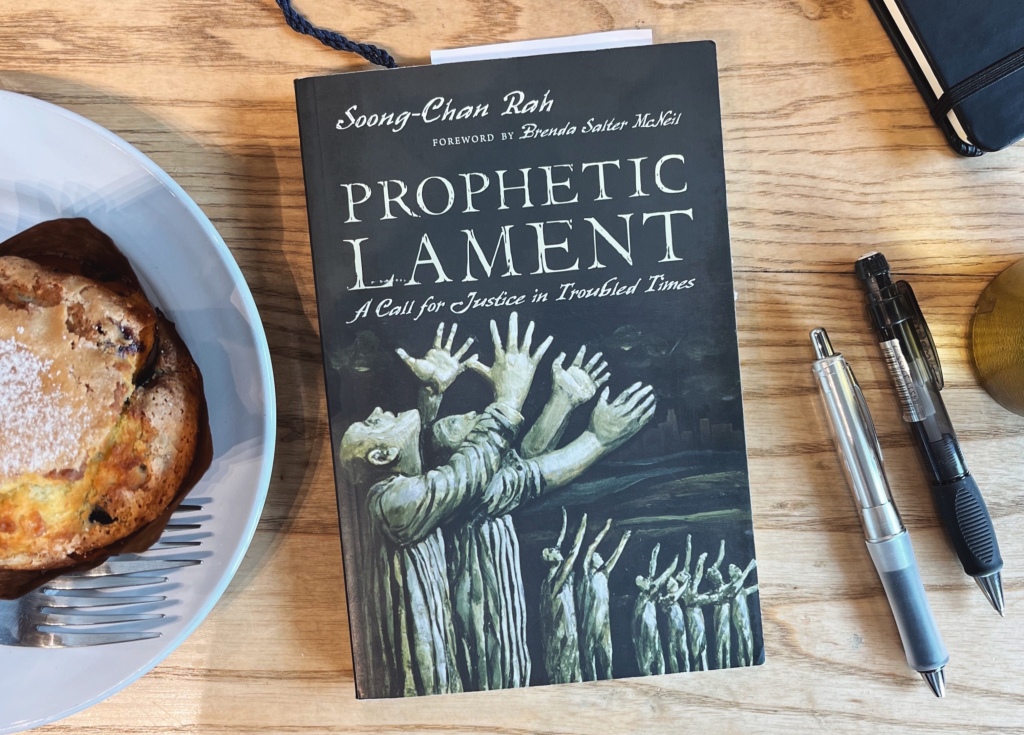
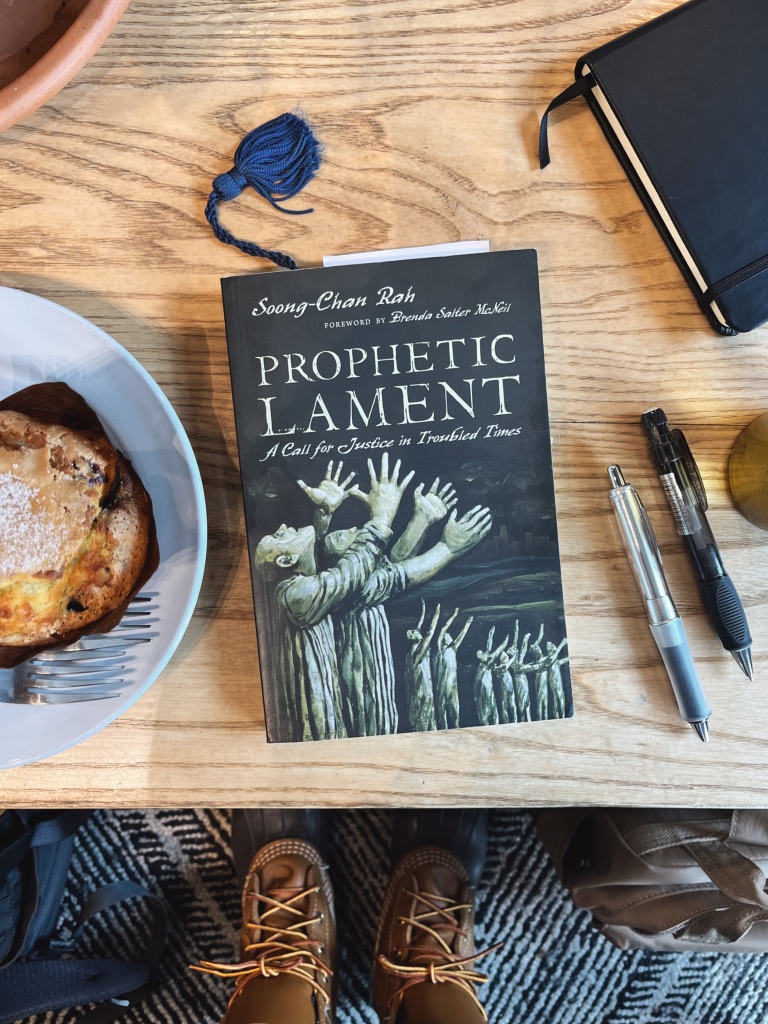
Prophetic Lament: A Call for Justice in Troubled Times, by Soong-Chan Rah

Some of my favorite quotations from this book:

“There is power in bringing untold stories to light.” 

“Lament serves the purpose of providing a necessary step toward praise.” 

“What would happen to our faith if we believed that God reigns sovereign over both our celebration and our suffering?” 

“Lamentations recognizes that individual voices from the full range of citizens must be heard. Lament requires the full and honest expression of suffering; that experience must encompass the full breadth of suffering. In contrast, American evangelical Christianity often presents only the story of the dominant culture. Often, the stories from the ethnic minority communities are not deemed worthy…The power of Lamentations is that the voices of those who have actually suffered are not missing.” 

“In many of our justice endeavors, we often believe that our task is to speak for the voiceless. But maybe we need to follow the book of Lamentations and move the ones who suffer to front and center. The prophet-narrator has much to say, but the real movement and progress is that we hear the actual voice of those who suffer.”

Start With Hello

Confession: I was supposed to publish this the week that this book launched into the world in October of 2022. I posted these words in a number of other places. But even though I had this post ready to go weeks in advance, when the day came, I forgot to hit the “publish” button. I actually didn’t realize this wasn’t already published until I opened up WordPress to write something else. So after months of being out in the world, let me tell you about a book:

Start With Hello, by Shannan Martin

In a society marked by hyper-individuality, a lack of real connection that leaves us lonely, and what feels like insurmountable division, we need Shannan’s words. Through her storytelling, she paints a picture of what our lives together as communities and a society can be. And through her practical wisdom, she gives us a path for how we can move in that direction. (One way she does that is by ending each chapter with “One Simple Way to Move toward Each Other.”)

She ends with “A Neighbor’s Blessing.” If any part of this blessing resonates with you, then this book is for you:

“May you go out into this bewildering world warmed by the fire of possibility.
May you come to see walking shoes, soup spoons, minivans, and wrinkled hands as worthy tools for connection.
May your heart stay tender, your hands stay open, and your door stay easy on its hinges.
May you find comfort in the moon, art in the clouds, and goodness in the faces around you.
May you gather, listen, and hope relentlessly.
And May you never give up on the living light if belonging, right where you are.
Grace and peace and gumption be with you.”

One more thing about this book stands out: In addition to people who resemble herself as a white woman, Shannan Martin gleans wisdom from diverse voices—including men and women who are Black, Asian, Latine, and Indigenous. This book is a demonstration of how learning from diverse voices makes our lived theology more robust.

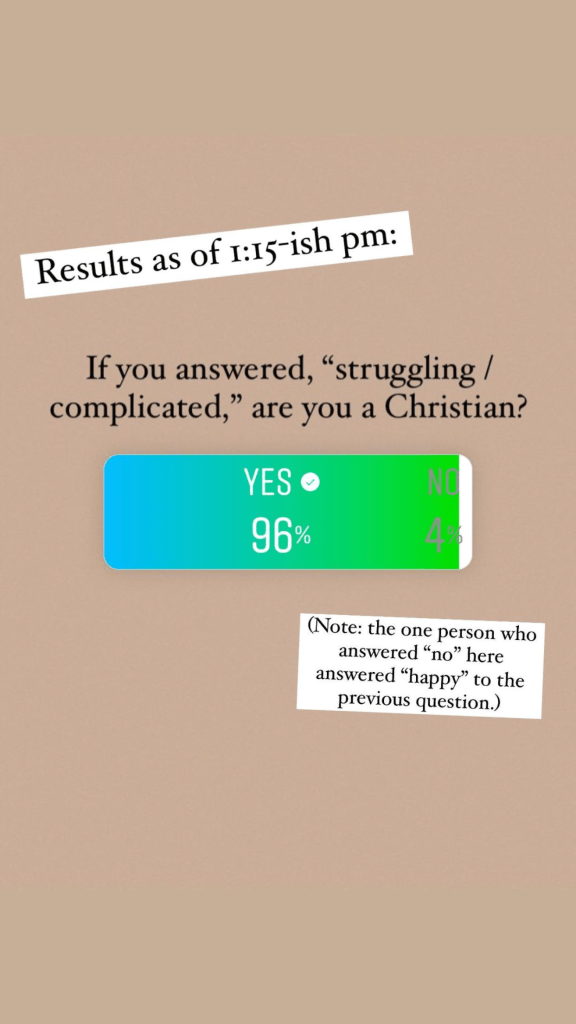
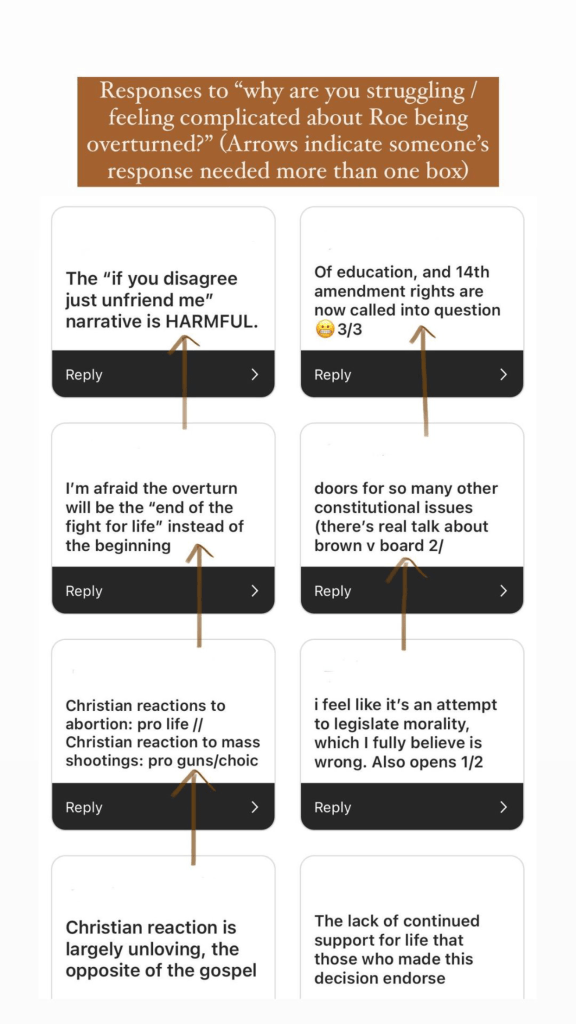
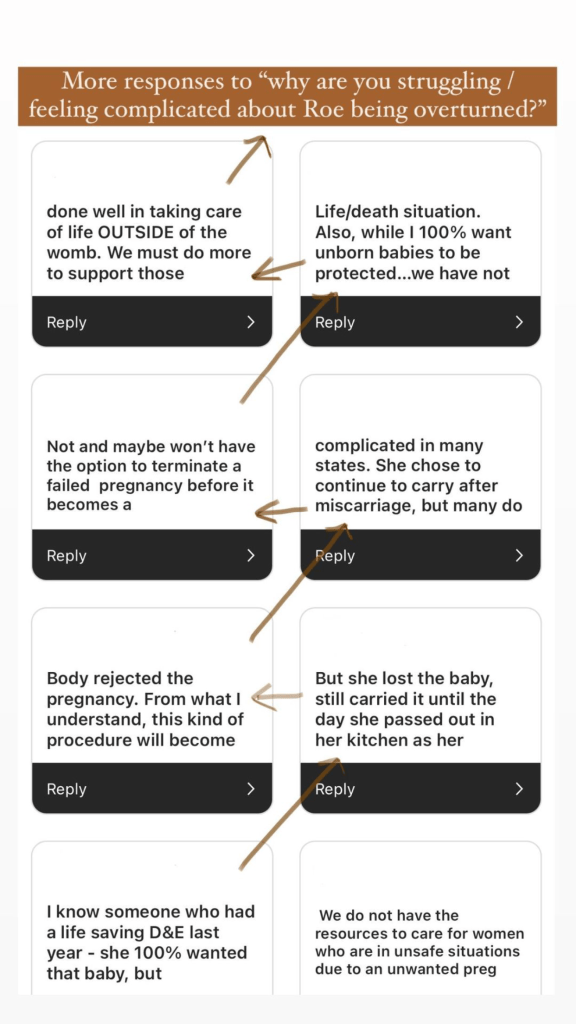
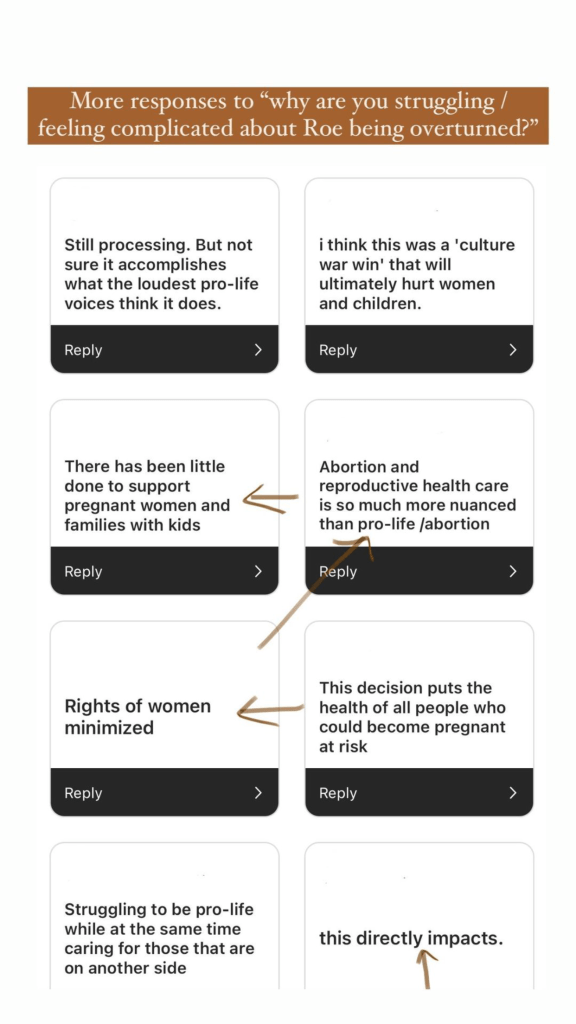
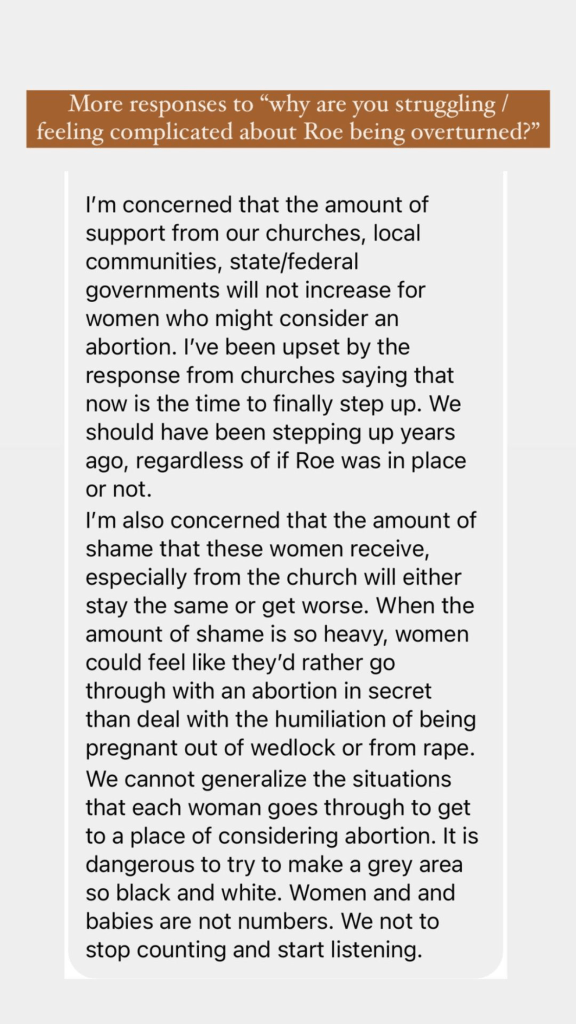
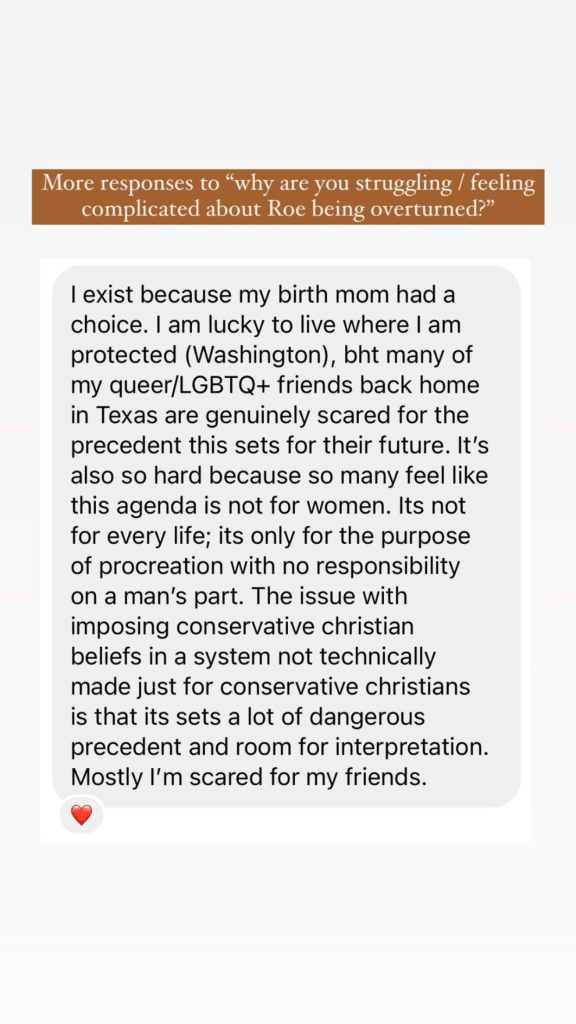
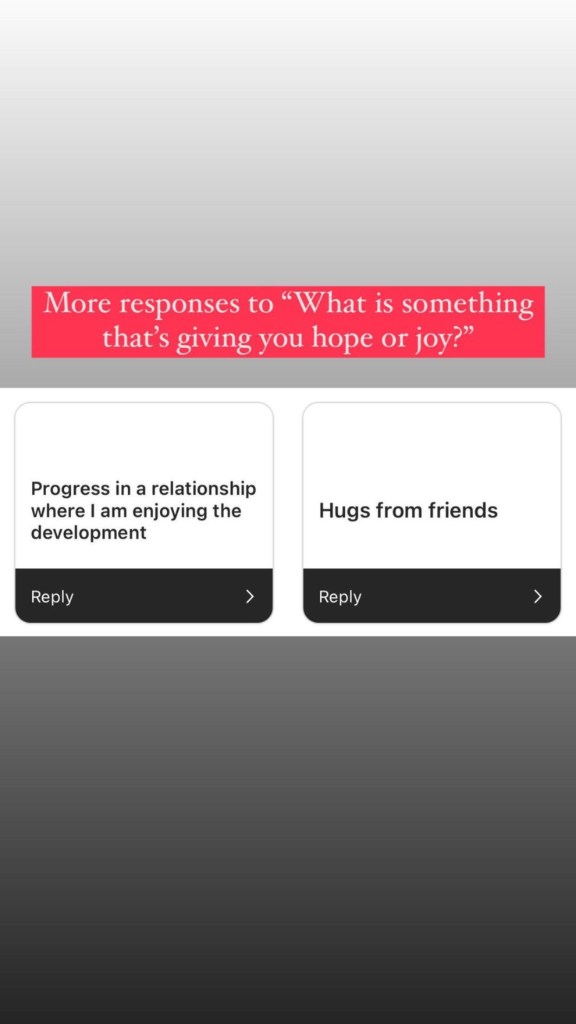
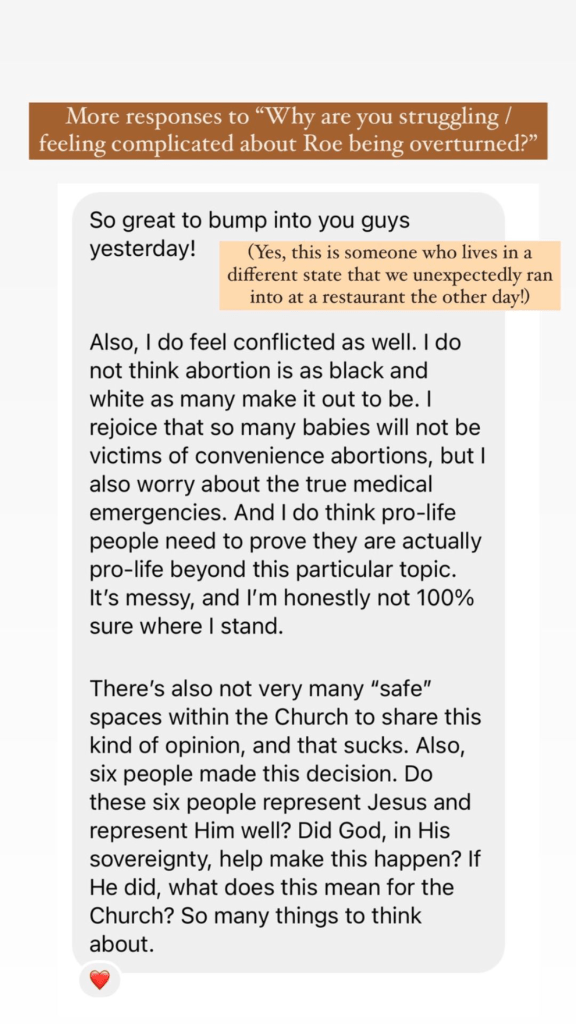
A Good Conversation: Our Feelings about Roe v Wade

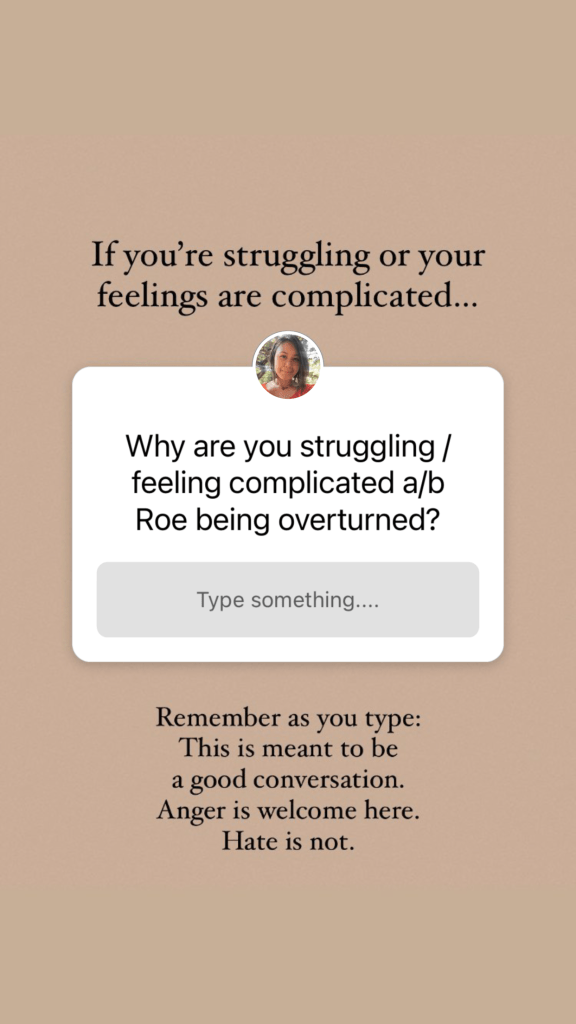
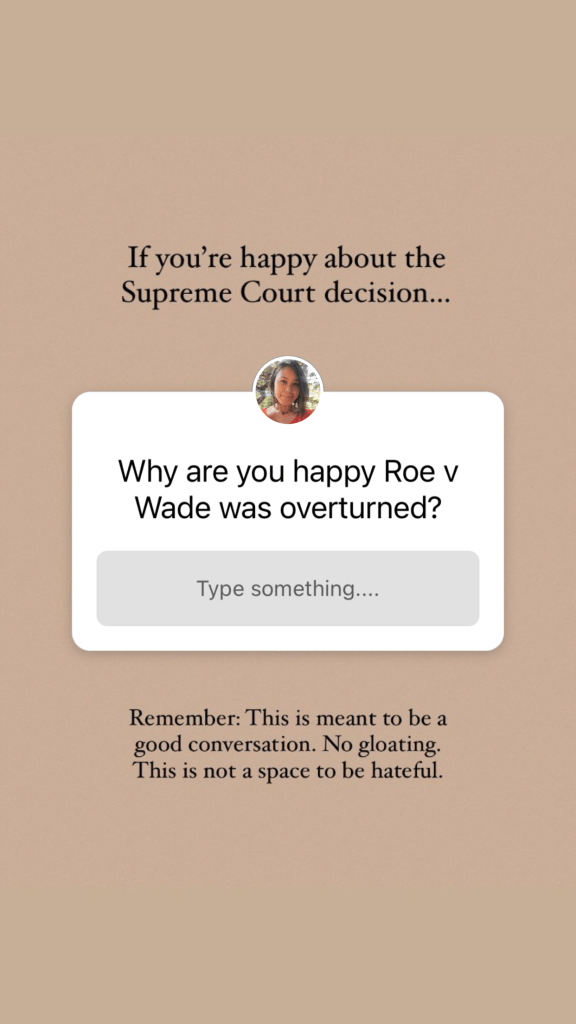
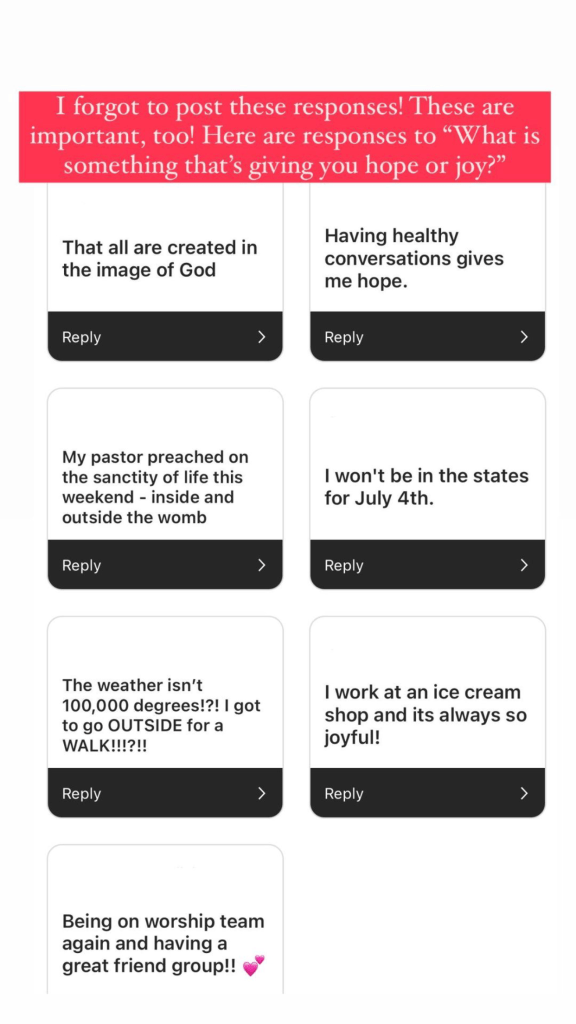
A few weeks ago I started something on Instagram called, “Good Conversations.” The goal is to pursue good. Not easy answers, not destruction, not an echo chamber. And even when we talk about hard things and the conversation gets messy, it’s so we can pursue good.

Also, I want the name “Good Conversations” to define our rules of engagement. These aren’t debates with winners and losers. We’re in this together. And this is a space where we treat others—even those with whom we disagree—with love, respect, empathy, compassion, etc. In other words, this is a space where we practice goodness. The feeling I have after a good conversation—the feeling of being seen, heard, loved, encouraged, energized, challenged in a good way—that’s what I want this to be for everyone.

If you’re on Instagram, you can participate in these conversations simply by responding to my weekly polls and questions. (To follow me, click here.) I’ll be saving each conversation in a highlight reel. For those who aren’t on Instagram, I’ll share some of these conversations here on my blog.

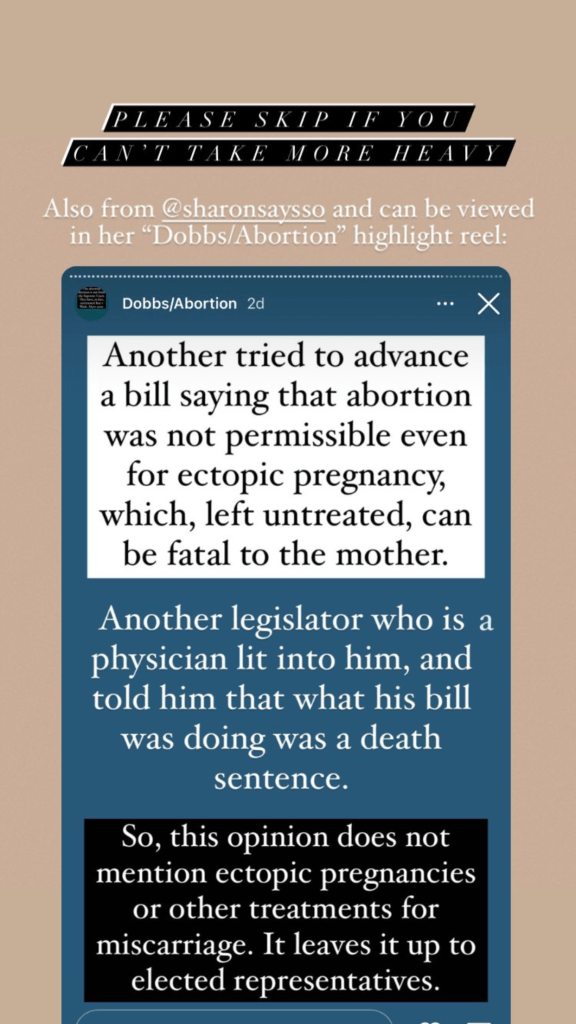
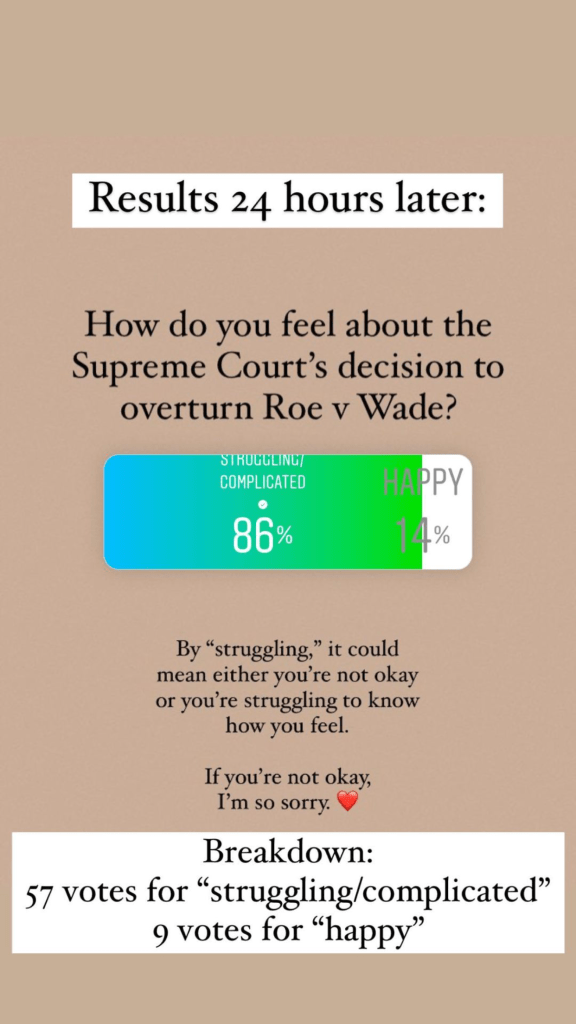
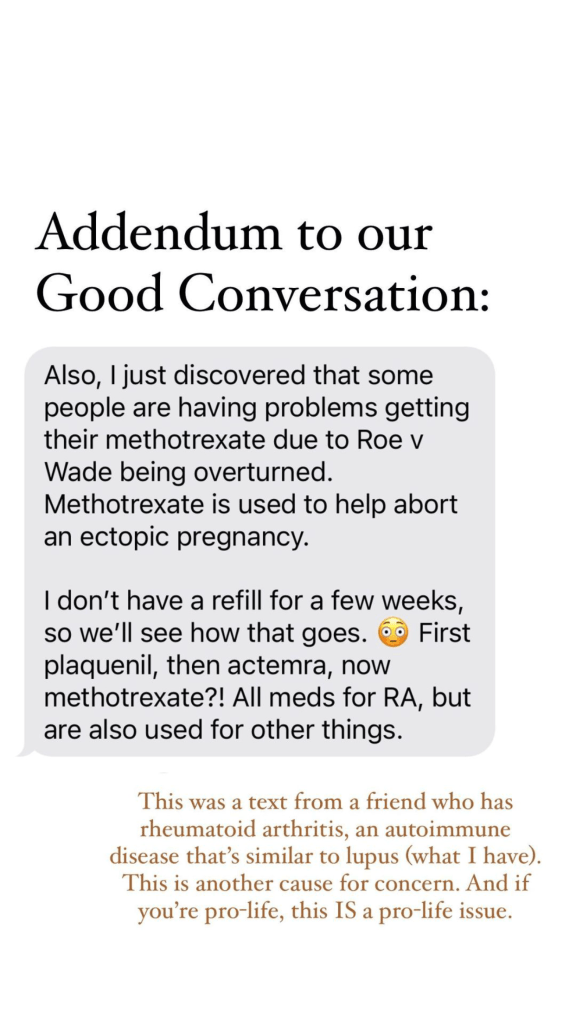
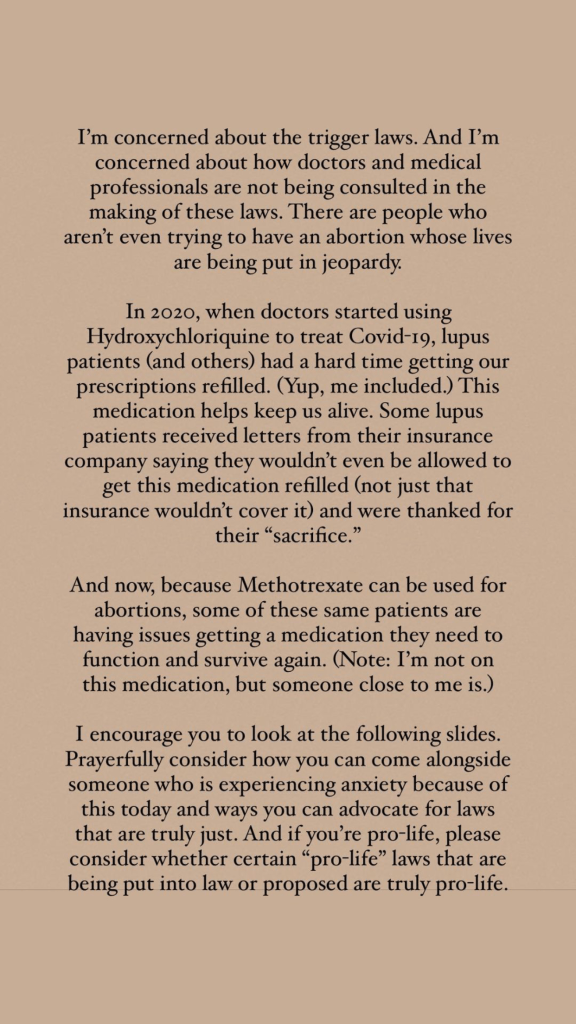
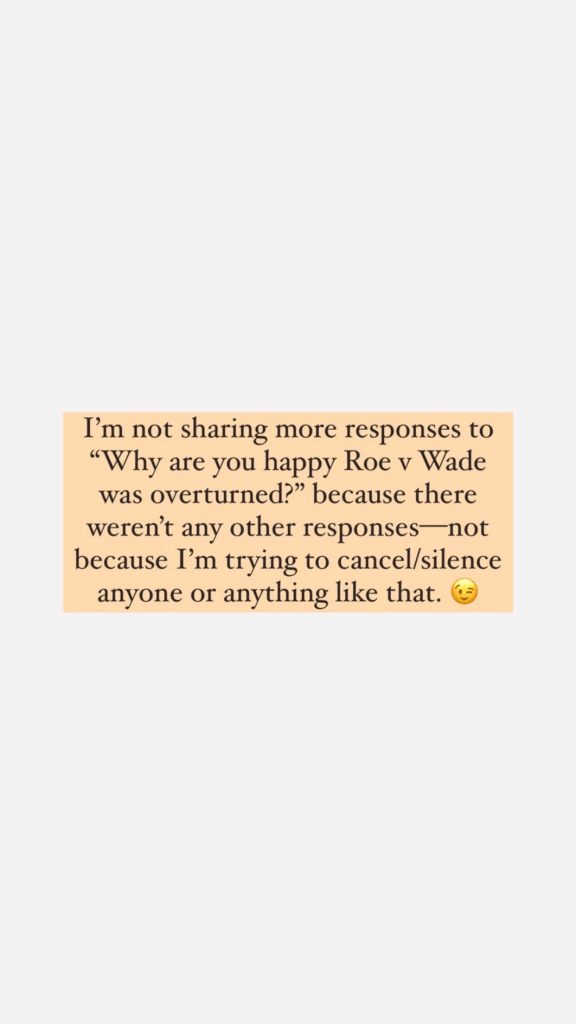
The topic of the first Good Conversation was a big one—our feelings about the Supreme Court’s decision to overturn Roe v Wade (which became official just a few days before this conversation). Here it is:

Click here for the link to this post.

When Following Jesus Requires Questioning

I went out for sushi with a friend. She’s the kind of friend I love talking with and who always leaves me feeling encouraged. During this particular conversation, I noticed something interesting:

Whenever she’d say, “I know I should…,” what followed would sound spiritual and “Christian”—like things I grew up hearing at church. But strangely, it wouldn’t sound like anything I’ve read about Jesus’ life in the Gospels. And when she’d apologetically say, “But I decided to…,” I’d be reminded of passages throughout Scripture and I’d see parallels between her life choices and the life Jesus modeled for us.

My friend is following Jesus. And in order to do that, she has to reject the patterns of this world—including ways the Church has adopted and spiritualized these patterns.

Isn’t that weird? At least, shouldn’t it be? And shouldn’t this be cause for alarm?

We’re followers / disciples / apprentices of Jesus. Whatever terminology you like to use, we’re to strive to look more and more like Him. But sometimes we confuse the way of Jesus with church culture. Church culture doesn’t always look and sound like Jesus. In fact, sometimes it’s conforming to church culture that prevents us from becoming more like Jesus. (What a brilliant way for the enemy to keep the Church from actually living like the Body of Christ! “Make it sound spiritual and put Jesus’ name on it, then they’ll accept it without question!”)

I want my heart to be aligned with Jesus’ heart, to look and sound like Him, to reflect Him every way I can. Unfortunately, that means there are times when I must make choices that go against the culture of the Church (or at least the American Church). And that means people who know church culture better than actual Jesus will accuse me of things that sound a lot like the things Jesus was accused of.

• What if we accepted Jesus’ invitation to learn from Him, diving deep into Scripture with humility in the fact that we don’t always get everything right and we still have more to learn?

• What if we investigated whether or not each supposed truth we label “biblical” is actually in the Bible and in alignment with the heart of God?

• What if we chose to follow Jesus—actually follow the words He spoke and the way He lived as it’s revealed in Scripture rather than what some people or our church culture tells us is “biblical”?

So here’s my challenge to you: The next time you find yourself thinking, “I feel like as a Christian I should…,” ask these two questions:

1. Does this thing I feel I should believe/think/do/be resemble what Jesus lived and taught? (If you can’t find it in Jesus’ life and teachings or anywhere else in Scripture, that’s a big red flag. So be specific. Where is it in Scripture? And if you find a verse, zoom out and look at the context of the chapter, book, and whole of Scripture. Is that really what that passage is saying? Or has it been misunderstood or taken out of context?)

2. What is the Spirit saying to me? Could it be that what the Spirit is saying to me contradicts something I’ve been taught but is actually in alignment with the way of Jesus as revealed in Scripture?

One more thing: Live this out in community. Find people who will ask these questions with you, lovingly call you out when you don’t live them, and aggressively encourage you when you do.