
At the start of every school year, Manna Christian Fellowship at Princeton University does a special Old Timers Large Group for sophomores, juniors, and seniors. What follows is the message I shared at this year’s Old Timers on September 3, 2025.
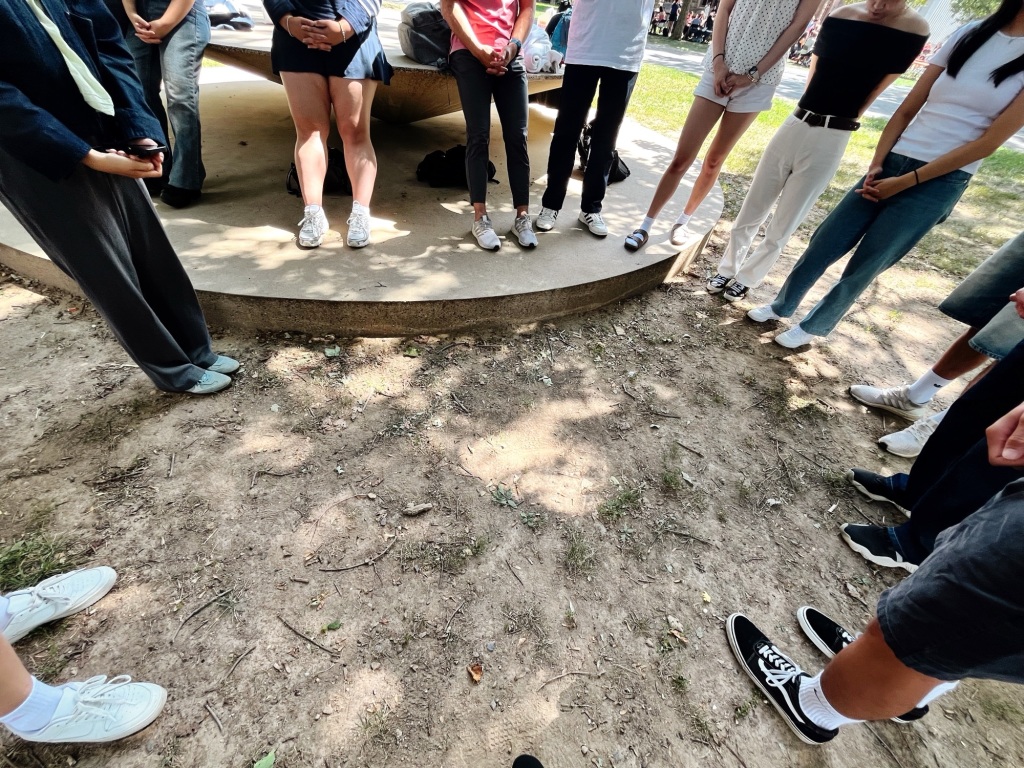
As we begin a new school year, here’s what I want you to get:
You are deeply loved by God.
And because you are deeply loved by God,
love God with your whole being, and love people without exception.
There’s a term in theology and Biblical studies: “synoptic Gospels.” In Manna, we talk a lot about the Gospel, the good news of the Kingdom of God. That word, gospel, also refers to the first four books in the New Testament: Matthew, Mark, Luke, and John. All four of them give an account of the life and teachings of Jesus. And the Synoptic Gospels refers to three of those books: Matthew, Mark, and Luke. The reason they’re called the synoptic Gospels is because they’re quite similar and have a lot of overlap. And John, though he talks about the same Jesus and there’s some overlap as well, his book is very different from the other three. Why are there differences in the accounts of the life of Jesus? If you had four different people telling you about the life of [pick random student], you’d hear four different accounts, different details and emphases, different ways of describing the same person. All true, but just from different perspectives. For example, Daniel and I get asked so many times how he proposed. I tell that story very differently from the way Daniel tells it. Which telling is right or more true? They’re both right, and they’re both true. And hearing it from both our perspectives gives you a fuller picture.
So here’s what we’re going to do. We’re going to explore a story that’s found in all three of the Synoptic Gospels. And then, we’ll see what John, the author of the last Gospel, has to say about the matter. And as we explore, I want you to consider two questions:
- Do I live like love is as important as Jesus said it was?
- What gets in my way of loving God and loving people?
The Perspective of Matthew
If you have your Bible, open up to Matthew 22. While you do that, let me give you some context. In the preceding chapter, chapter 21, Jesus rode into Jerusalem on a donkey, and there were palm branches, and people were shouting, “Hosanna to the Son of David!” It was basically a royal procession. And after that, Jesus went into the temple, and He started flipping over the tables of the money changers and those selling doves. This was happening in the Court of the Gentiles, the place that was supposed to be where those from every nation could come and worship God, but that place was being overrun by people who were distorting sacrifice and worship into a commercial endeavor, thereby excluding the nations to whom God had called His people to be a blessing. Jesus flipped the tables of injustice, and the religious leaders got mad and began to search for a way to do away with Him. So in chapter 22, we see various groups approaching Jesus, trying to trap Him with different theological tests/questions. In Matthew 22:34, we come to their last test to Jesus.
Matthew 22:34-40 (CSB)
When the Pharisees heard that he had silenced the Sadducees, they came together. And one of them, an expert in the law, asked a question to test him: “Teacher, which command in the law is the greatest?”
He said to him, “Love the Lord your God with all your heart, with all your soul, and with all your mind. This is the greatest and most important command. The second is like it: Love your neighbor as yourself. 40 All the Law and the Prophets depend on these two commands.”
After this, Jesus turned around and presented them with a question and they weren’t able to answer Him. Then in Matthew 23:1-4, the story continues.
Matthew 23:1-4 (CSB)
Then Jesus spoke to the crowds and to his disciples: “The scribes and the Pharisees are seated in the chair of Moses. Therefore do whatever they tell you, and observe it. But don’t do what they do, because they don’t practice what they teach. They tie up heavy loads that are hard to carry and put them on people’s shoulders, but they themselves aren’t willing to lift a finger to move them.
Jesus calls us to a love that is embodied and seen through action rather than being enslaved to legalism, perfectionism, purity tests, and the appearance of piety.
The Perspective of Mark
Let’s look at Mark 12. The context here is the same as the book of Matthew: Jesus flipping over tables of injustice, the religious leaders trying to trap Him. But when we get to Mark 12:28, the tone shifts.
Mark 12:28-34 (CSB)
One of the scribes approached. When he heard them debating and saw that Jesus answered them well, he asked him, “Which command is the most important of all?”
Jesus answered, “The most important is Listen, Israel! The Lord our God, the Lord is one. Love the Lord your God with all your heart, with all your soul, with all your mind, and with all your strength. The second is, Love your neighbor as yourself. There is no other command greater than these.”
Then the scribe said to him, “You are right, teacher. You have correctly said that he is one, and there is no one else except him. And to love him with all your heart, with all your understanding, and with all your strength, and to love your neighbor as yourself, is far more important than all the burnt offerings and sacrifices.”
When Jesus saw that he answered wisely, he said to him, “You are not far from the kingdom of God.” And no one dared to question him any longer.
What strikes me about Mark’s telling is that the scribe seemed genuinely interested. And Jesus’ positive response to him makes me wonder what happened to this scribe. Did he ever become a follower of Jesus? We don’t know. All we know is that in this moment, as he demonstrated an understanding of the supremacy of love, Jesus said he was “not far from the kingdom of God.”
As we keep reading a few verses later, starting in verse 38,
Mark 12:38-44 (CSB)
He also said in his teaching, “Beware of the scribes, who want to go around in long robes and who want greetings in the marketplaces, the best seats in the synagogues, and the places of honor at banquets. They devour widows’ houses and say long prayers just for show. These will receive harsher judgment.”
Sitting across from the temple treasury, he watched how the crowd dropped money into the treasury. Many rich people were putting in large sums. Then a poor widow [Remember that Jesus just talked about scribes devouring widows’ houses.] came and dropped in two tiny coins worth very little. Summoning his disciples, he said to them, “Truly I tell you, this poor widow has put more into the treasury than all the others. For they all gave out of their surplus, but she out of her poverty has put in everything she had — all she had to live on.”
So many people preach this passage to say, you need to be like the poor widow and sacrifice everything you have for God. But read in context, this is not that. Nowhere does Jesus say that what this widow was doing was a good thing. He wasn’t criticizing her, but His words weren’t exactly praise either. It was more like lament. He was saying, “Here is a living example of the way scribes and religious leaders are devouring widow’s houses and causing them to be destitute. Look at the inequity of someone who has very little giving everything, while people who have everything give comparatively very little.” This year, our theme in large group is going to be “Jubilee.” You can read about the idea of Jubilee in Leviticus 25 and Luke 4:16-21. But for now what I want you to know is what was happening in this passage, what the religious leaders and rich people were doing and allowing to happen to widows was not jubilee and was antithetical to the Gospel.
The scribe understood and could wax eloquently about the command to love God and love people, but there was a disconnect between the knowledge the scribes had and how they lived their lives. The scribes were pious and they prayed long prayers, but they were also greedy and unjust. Love does not tolerate injustice.
The Perspective of Luke
Luke puts this story earlier in the narrative and in Jesus’ ministry. Jesus wouldn’t flip the tables of injustice until chapter 19. If you glance at the subject titles leading up to this point, you’ll see things related to Jesus’ identity and His mission, as well as His invitation to His followers to be like Him and participate in that mission (“Peter’s Confession of the Messiah,” “His Death and Resurrection Predicted,” “Take Up Your Cross,” “The Power of Jesus over a Demon,” “Sending Out the Seventy-Two…”). With that setup in mind, let’s read Luke 10:25-37.
Luke 10:25-37 (CSB)
Then an expert in the law stood up to test him, saying, “Teacher, what must I do to inherit eternal life?”
“What is written in the law?” he asked him. “How do you read it?”
He answered, “Love the Lord your God with all your heart, with all your soul, with all your strength, and with all your mind,” and “your neighbor as yourself.”
“You’ve answered correctly,” he told him. “Do this and you will live.”
But wanting to justify himself, he asked Jesus, “And who is my neighbor?”
This expert in the law was basically asking Jesus, “Who do I have to include and who am I allowed to exclude?” And Jesus’ response was scandalous. “You think you’re an expert in the law? Let me tell you a parable about how the kind of people that you look down on understand the law better than you.”
Jesus took up the question and said, “A man was going down from Jerusalem to Jericho and fell into the hands of robbers. They stripped him, beat him up, and fled, leaving him half dead. A priest happened to be going down that road. When he saw him, he passed by on the other side. In the same way, a Levite [another religious leader], when he arrived at the place and saw him, passed by on the other side. But a Samaritan on his journey came up to him, and when he saw the man, he had compassion. He went over to him and bandaged his wounds, pouring on olive oil and wine. Then he put him on his own animal, brought him to an inn, and took care of him. The next day he took out two denarii, gave them to the innkeeper, and said, ‘Take care of him. When I come back I’ll reimburse you for whatever extra you spend.’
Through the story of the Good Samaritan, we see a love that’s not abstract, but concrete:
What does concrete love look like? Three phrases:
- I see you.
- I’m here for you.
- I’ve got your back.
- The Samaritan didn’t just see that the man was there. The religious leaders saw him, too. But they didn’t see him in his full humanity, as someone created in the image of God and loved by God, who was suffering and in need of care. But the Samaritan truly saw him and was compassionate enough to stop.
- He bandaged his wounds (which means he was willing to look at some ugliness)
- He gave his resources: oil, wine, money. And where did he get bandages? Did he rip up his own clothes or another one of his valuables to make bandages for this stranger?
- He gave his time, not just in that moment, but in the days to come.
- And the Samaritan made sure the man was safe and out of harm’s way.
“Which of these three do you think proved to be a neighbor to the man who fell into the hands of the robbers?”
“The one who showed mercy to him,” he said.
Then Jesus told him, “Go and do the same.”
Here’s the beautiful thing: Jesus wasn’t like the religious leaders who didn’t practice what they taught. In Jesus’ life—His incarnation, crucifixion, resurrection, through His teachings, and presence, and miracles, and in the ways that He advocated for the marginalized and cared for the broken—He communicated over and over again: “I see you, I’m here for you, and I’ve got your back.” And He is still speaking and living those words for us today. That is love.
The Perspective of John
Throughout the Gospel of John, there’s so much talk of love. John 3:16—“For God so loved the world…”.John 15—”Remain in my love…” Rather than going to the Gospel of John, I’m going to have us go to one of his letters at the end of the Bible.
1 John 4:7-11, 18-21 (CSB)
Dear friends, let us love one another, because love is from God, and everyone who loves has been born of God and knows God. The one who does not love does not know God, because God is love. God’s love was revealed among us in this way: God sent his one and only Son into the world so that we might live through him. Love consists in this: not that we loved God, but that he loved us and sent his Son to be the atoning sacrifice for our sins. Dear friends, if God loved us in this way, we also must love one another.
There is no fear in love; instead, perfect love drives out fear, because fear involves punishment. So the one who fears is not complete in love. We love because he first loved us. If anyone says, “I love God,” and yet hates his brother or sister, he is a liar. For the person who does not love his brother or sister whom he has seen cannot love God whom he has not seen. And we have this command from him: The one who loves God must also love his brother and sister.
You are deeply loved by God. And because you are deeply loved by God, love God with your whole being, and love people without exception.
Now here’s the thing: Love is not some fluffy, light, easy thing. Love is messy. It takes work, laying down our pride, sacrifice, and vulnerability. Love is brave. And Jesus didn’t just tell us to love our friends and the people in our community. He also told us to love our enemies. And He told a story about how the people we look down on or despise may be the ones who need to teach us how to love.
Love is hard. And we mess up. We fail to love God. And we fail to love people well. So what do we do?
Let’s look at one more passage written by John, except this time in the wonderfully weird book of Revelation. Revelation 2:1-5. This book is a series of visions that John had. And in this passage, he’s told to write letters to various churches.
Revelation 2:1-5 (CSB)
“Write to the angel of the church in Ephesus: Thus says the one who holds the seven stars in his right hand and who walks among the seven golden lampstands: I know your works, your labor, and your endurance, and that you cannot tolerate evil people. You have tested those who call themselves apostles and are not, and you have found them to be liars. I know that you have persevered and endured hardships for the sake of my name, and you have not grown weary. But I have this against you: You have abandoned the love you had at first.
In the IVP Bible Background Commentary, Dr Craig Keener wrote, “Sound doctrine and perseverance are inadequate without love.”
So back to the question: What do we do? What do we do when we’re not loving God or living out of that love?
John goes on:
Revelation 2:5 (CSB)
Remember then how far you have fallen; repent, and do the works you did at first.
Jesus doesn’t say, “The moment you fail to love well, that’s it. I’m done with you.” No. He says, to repent (to turn back to Him), and to do the works you did at first (to be with Him, not just to ask Him for things, but to be with Him), and keep coming back to Him and to His love. Now just to be clear: in saying “do the works you did at first,” this does not mean you need to do works to earn God’s love. You cannot earn God’s love; God loves you. Period. So why talk about doing works? Because it takes work to cultivate our love for God and for others. And, like we saw in the Gospels, love is not some abstraction. It is concrete, made visible through action. So every day, keep returning to Jesus and keep doing the things that cultivate your love for Him and others
So here’s what I want you to carry with you as you start this new school year and for the rest of your life:
You are deeply loved by God. And because you are deeply loved by God, love God with your whole being, and love people without exception.
Let everything you do and everything you strive to be flow out of that love.
 Esther Guy